


I'm re-reading Thinking Mathematically, an assigned book from a math course I took years ago in Portland. I was teaching science at the time, but I signed up anyway because I’ve always loved math.
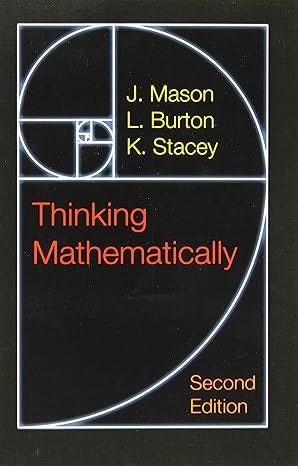
Thinking is still so good—and resonates even more now that I’ve been teaching math.
In the Introduction, under "How to use this book effectively!":
Recalcitrant questions which resist resolution should not be permitted to produce disappointment. A great deal more can be learned from an unsuccessful attempt than from a question which is quickly resolved, provided you think about it earnestly, make use of techniques suggested in the book, and reflect on what you have done. Answers are irrelevant to the main purpose of this book. The important thing is to experience the process being discussed.
Yes, please.
The authors lay out five assumptions their approach rests on:
You can think mathematically.
Mathematical thinking can be improved by practice and reflection.
Mathematical thinking is provoked by contradiction, tension, and surprise.
Mathematical thinking is supported by an atmosphere of questioning, challenging, and reflecting.
Mathematical thinking helps in understanding yourself and the world.
These assumptions need to live in our classrooms.
The problems in Thinking are short and simple-looking—but they linger. They’re not just “productive struggle,” they’re sweet struggle.
Some favorites:
How many rectangles are there on a chessboard? [Page 43]
I have just run out of envelopes. How should I make myself one? [Page 35]
A certain village in Jacobean times had all the valuables locked in a chest in the church. The chest had a number of locks, each with its own key. The aim of the village was to ensure that any three people could open it together, but no two people could. How many locks are needed? How many keys? [Page 176]
I just found out the 2nd edition came out in 2010. Amazon doesn’t have it in stock right now, but when it does, the rental is $54.77 and a new copy is $91.29.