


As we wrapped up our book study of Peter Liljedahl’s Building Thinking Classrooms, I wanted to facilitate a thinking task using vertical whiteboards with students — even though, as a TOSA (teacher on special assignment), I don’t have a classroom of my own. So I asked one of our first-grade teachers if I could borrow hers.
To help supplement the existing whiteboard space, I reached out to Wipebook, and they sent us reusable Flipcharts — dry-erase chart paper with grids on one side. Perfect for glass doors and windows! They're easily removable and reusable, which makes them an eco-friendly win. Our district also has whiteboard easels with adjustable heights, which helped too.
The teacher already had her kids paired up with “thinking partners.” Each board was labeled — like “Blue 1 and 2” — so students knew where to go.
We gathered on the carpet to launch the task. I taped up this flower image and asked, “How many circles do you see?” They said seven.

I then counted out seven sticky notes, labeled 1 through 7. This beautiful Flower Petal Puzzle is from Dan Finkel of Math for Love. The goal is to place the numbers into the petals so that the sums of the connected petals are equal. Dan suggests using counters, but since we were working vertically, I used sticky notes — they made it super easy for students to swap numbers and keep moving forward without getting bogged down by erasing.

I called up one student at a time to place a sticky note into an empty petal. No directions, no goal stated. When there was only one petal left, I said it was my turn and placed the last number.
I wish I had snapped a picture of that board! But imagine the petals filled randomly. Then I pointed to a group of three connected petals and asked for the sum. We wrote the equation. Then we did this for the other two connected sets.
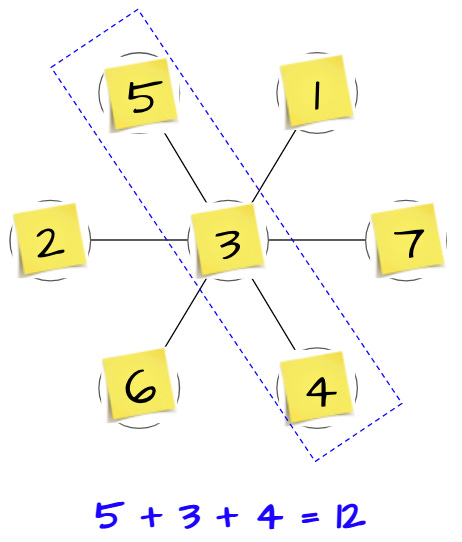
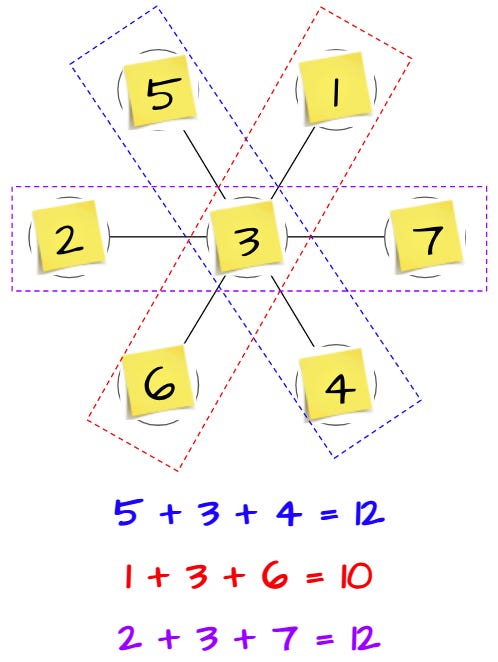
Only then did I share the challenge:
Make all three sums equal — and make that sum 10.
Off they went, partners in tow, working at their whiteboards!
Sure enough, one pair solved the puzzle within 5 minutes. I asked them to leave their equations up and move on to the next challenge: a sum of 12. One by one, the other groups figured out the sum-of-10 version. Two groups were still stuck when I offered a clue: “Try putting 1 in the center.” They took the suggestion, and when they solved it, one girl beamed, “This is a lot of fun!”
Honestly, it was the best hour I’ve spent with first graders — so much perseverance, thinking, and joy. By the end, groups were in different stages — some on the sum of 14, and two groups ended the hour working on the “ultimate challenge” using a 9-petaled flower.