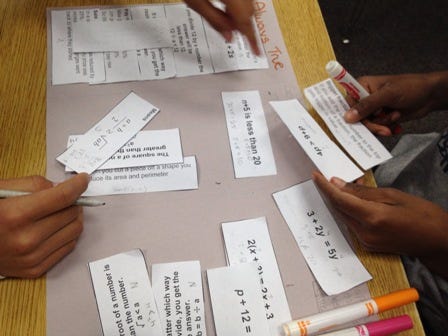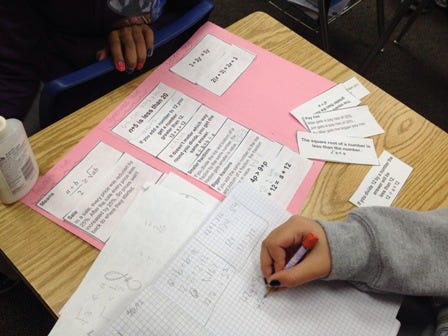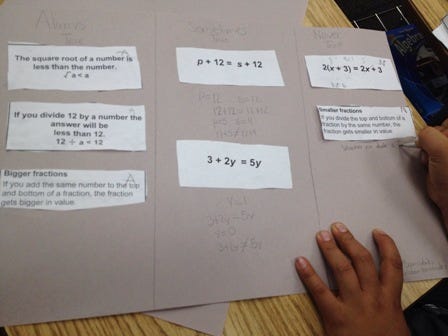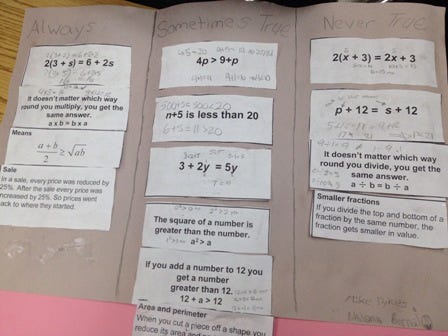

I did Always-Sometimes-Never (ASN) questions with my 6th graders. Students were randomly paired and asked to place 18 mathematical statements into the appropriate columns: always true, sometimes true, or never true.
They were totally into it—discussing, debating, coming up with examples. Some statements needed to be translated into equations or inequalities. And if a group thought something was only sometimes true, they had to defend it with reasoning or provide a counterexample.
What I love is that ASN works for any level of math—and honestly, it could be used in other subjects too. It creates space for dialogue. The kids are comfortable reasoning things out one-on-one first, and that gives them the confidence to share their thinking with the full group later.
Some statements that we used:
Max gets a pay raise of 30%. Jim gets a pay raise of 25%. So Max gets the bigger pay raise.
When you cut a piece off a shape, you reduce its area and perimeter.
If you add the same number to the top and bottom of a fraction, the fraction gets bigger in value.
In a sale, every price was reduced by 25%. After the sale, every price was increased by 25%. So the prices went back to where they started.
If you divide the top and bottom of a fraction by the same number, the fraction gets smaller in value.
If you add a number to 12, you get a number greater than 12.
The square root of a number is less than the number.
If you divide 12 by a number, the answer will be less than 12.
The square of a number is greater than the number.