


The young nurse asks how my day is going as she wraps the blood pressure cuff around my arm. I pretend to be relaxing on a yacht to yield low numbers, and the machine beeps 124/74. Dammit, I’ve never been above 120 — the yacht is sinking and death is near. She tells me the procedure I’m about to undergo is quick. Math practice number six beckons, and I ask, “What is quick? Like five-seconds-kinda-quick or...?” She smiles, “About fifteen minutes.”
I want to choke her. I hate pain. Any kind of pain. Especially the needle-poking kind. You know the 0–10 pain scale they post in exam rooms? Getting a flu shot is at least a 7 for me.
The doctor, who also looks very young, explains the procedure she’ll be performing. Her voice is remarkably well-modulated and soothing — not quite enough to drown out words like a long needle, grade two, some pain, numbing, cauterize, burn, death. Maybe I imagined that last one. I want to ask where she trained, how many times she’s done this, but I’m afraid that sounds like profiling, which might cause her dulcet voice to morph into a shriek: You are the worst patient! I should just let you bleed to death!
I want to hold someone’s hand. I need to hold someone’s hand. I’m tempted to ask the nurse, but she’s busy gathering scalpels, chisels, and cleavers for the doctor. I should’ve brought a fake hand to hold. I settle on holding my own, right hand holding left. I want to pass out. Instead, a few minutes in, I can’t hold back the tears. I’m quietly sobbing. I ask for some tissue. The doctor’s soft voice: “Are you okay? We got you. Here you go, you can have the whole box.”
She asks about my pain level. I tell her, honestly, that I’m okay — pain-wise. “I’m just stressed.” My brother Vinh passed away two weeks ago. My cat Charlie has been missing since the night before. And now, this.
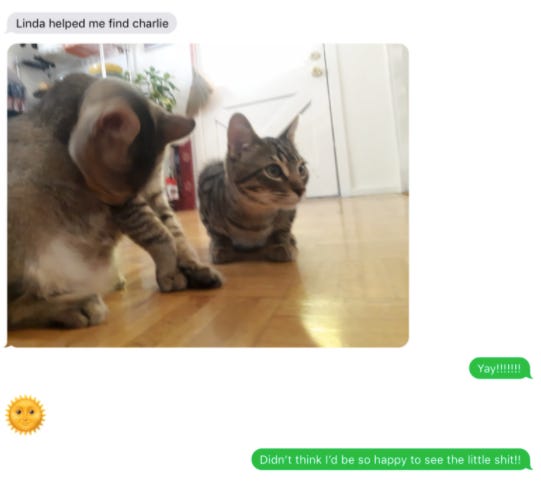
I drive straight to work afterward. A few hours later, my son Gabriel texts me a photo of Charlie, safe and sound. (Charlie is in the front. The other monster is Tugboat.)
My math coaching job is great. It’s new yet familiar, structured yet flexible. No one needs to remind me how tough teaching is. But I forgot. I forgot all the things that became second nature to me — classroom management, building rapport, advocating for kids, planning a lesson.
Now I get the privilege of observing classrooms, modeling number talks, co-teaching tasks, designing lessons, working with younger students, facilitating PD, creating slide decks and documents that might be useful. There are three of us TOSAs in the district — English, ELD, and Math. I don’t see the other two smart, strong, caring women much outside of meetings, but they make me laugh and I admire them deeply.
There’s something special here. A kind of DNA, like the kind Coach Cristobal from the Oregon Ducks talks about — the DNA of each player that adds to the team’s collective DNA. The culture is good. My bosses are passionate and grounded, with deep roots in the community — because they are the community. Their history is their present. It’s a cool place to be, and I feel very lucky to be part of such a hardworking and caring network.
On the pain scale, work hasn’t exceeded level 1, so I’m grateful. Wouldn’t it be something if our emotional pain level were visible to others — and our job as humans was to lower each other’s numbers? And the more people’s numbers we could lower, the lower ours would get too.
Kindness is a potent pain reducer. And it can be self-administered.