


I recently presented to math leaders in St. Louis and at last year’s NCSM about the UCSB Math Project professional development program I’m part of. Figured I’d share it more widely here because it actually works—and it’s the longest I’ve been committed to any professional organization (since 2011).
The UCSB Math Project is part of a three-tier system that starts at the state level with the California Subject Matter Project—an umbrella organization launched in 1988 that houses nine different subject-specific projects. Within that, the California Mathematics Project operates at the county level across 11 regions throughout the state. Our local site serves Region 8, covering Kern, San Luis Obispo, Santa Barbara, and Ventura counties.
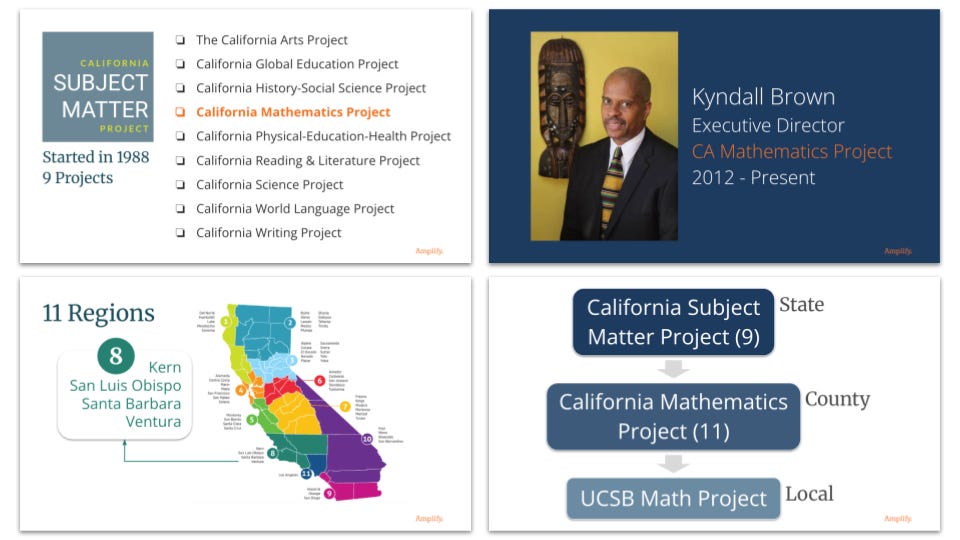
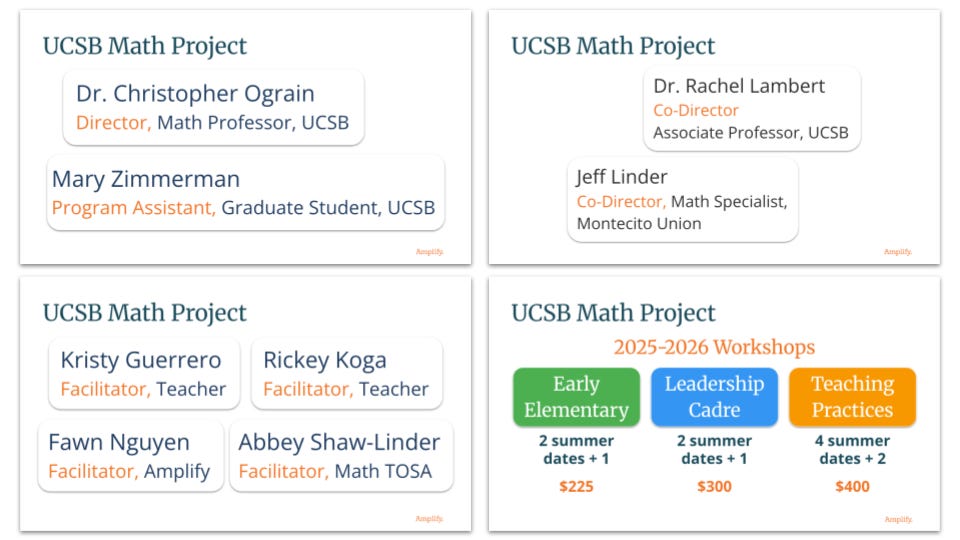
Mary, our program assistant, is exempt from leading any sessions because she's already handling the behind-the-scenes work that keeps everything running—paperwork, breakfast, lunch, all of it. The rest of us split up the facilitation across the three workshop tracks you see below. Each workshop has at least three of us leading.
We start with a summer institute when teachers have time to really dive in. Then during the school year, we follow up where it matters most—in actual classrooms, modeling lessons and supporting teachers in real time.
Registration runs $225 to $400 depending on the workshop. Last year, ALL registrations were paid by school districts, so no one paid out of pocket. Teachers can also earn UCSB graduate credit if they want—costs a bit extra, but it counts toward salary advancement or credential renewal.
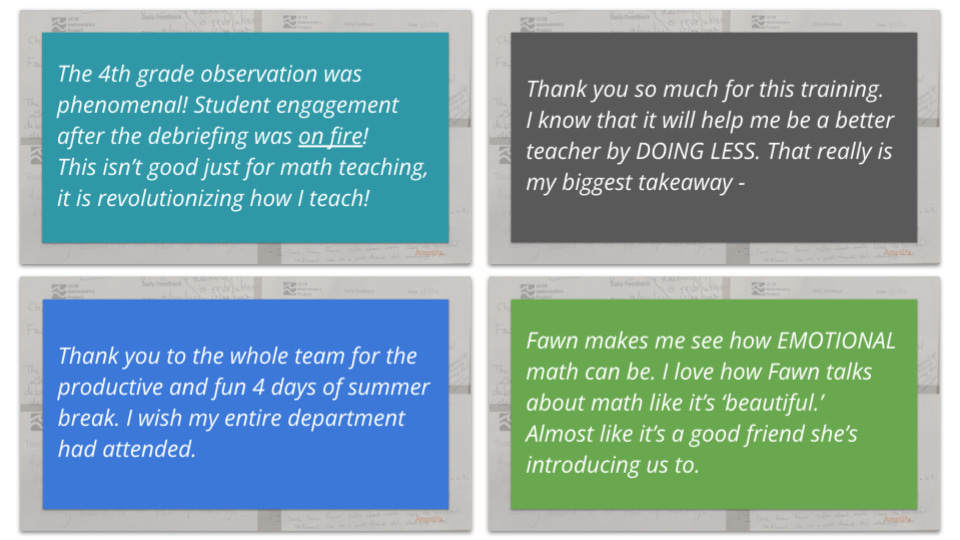
I made that bold claim at the start—that our PD actually works—because of feedback like this, including one all about me because, hell, it's my post.
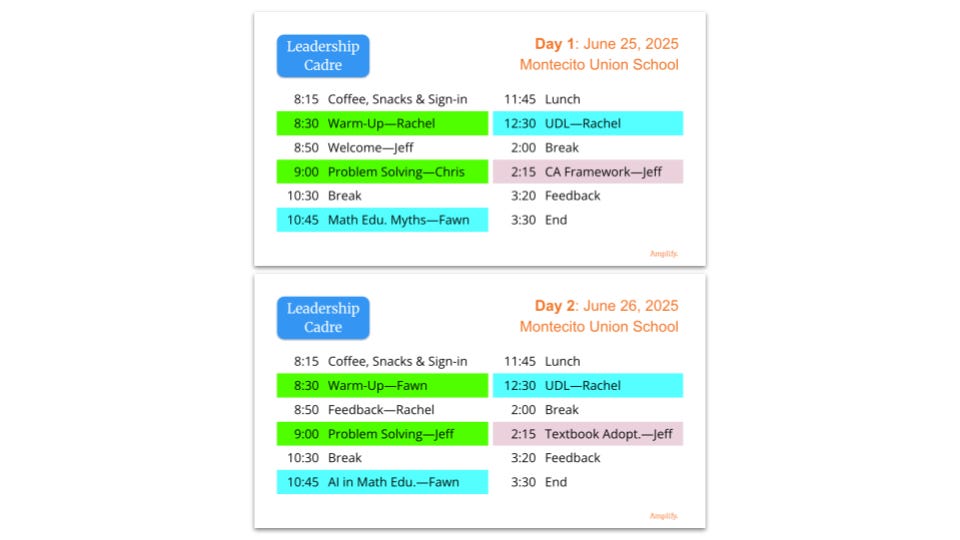
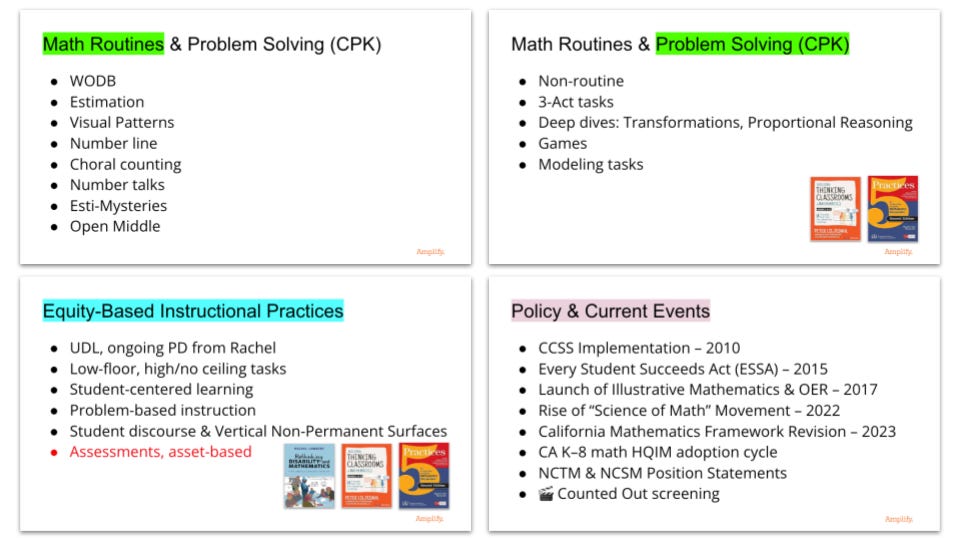
Below is our 2-day agenda for the Leadership Cadre held last June. Every agenda has these three components: green is math content, blue is equity, and pink is policy. Right after the math warm-up on Day 1 of any workshop, Jeff kicked things off with a welcome. He shared the Project's mission statement, our goals for the workshop, and established norms for how we'd work together. Then everyone introduced themselves—name, school site, and why they wanted to be there. Notice we got this done in 10 minutes. Ten minutes.
Here's a breakdown of the three main components we've covered over the years. The three books you see—Building Thinking Classrooms in Mathematics, 5 Practices for Orchestrating Productive Mathematics Discussions, and Rethinking Disability and Mathematics—anchor much of what we do. The one area we haven't fully tackled yet is assessments. We want to explore models like standards-based grading and asset-based assessments. How well are they being implemented? What are the challenges?
Because this is the Leadership Cadre workshop, another component is building leadership skills. We're not just teaching math routines or UDL strategies—we're growing leaders who will go back to their sites and say, "This is how we're going to do math differently. This is how we ensure every kid gets access to the real thing." Some folks start small: present one 3-Act task to the group, apply for a conference grant to attend CMC or NCTM. Others go deeper—co-presenting at conferences, recruiting colleagues to join the next cohort. Some come back year after year and eventually return as facilitators themselves. Five of us, by the way, started as participants.
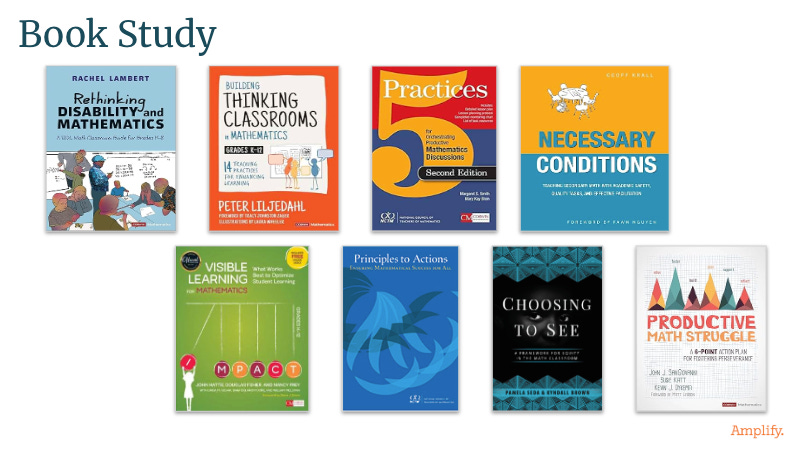
The bonus component is book study—though calling it a "study" might be generous since the schedule is full. We pick a relevant book and pull sections into conversations as they fit. A book study does two things: it builds shared language, and it positions teachers as intellectuals, not just technicians.
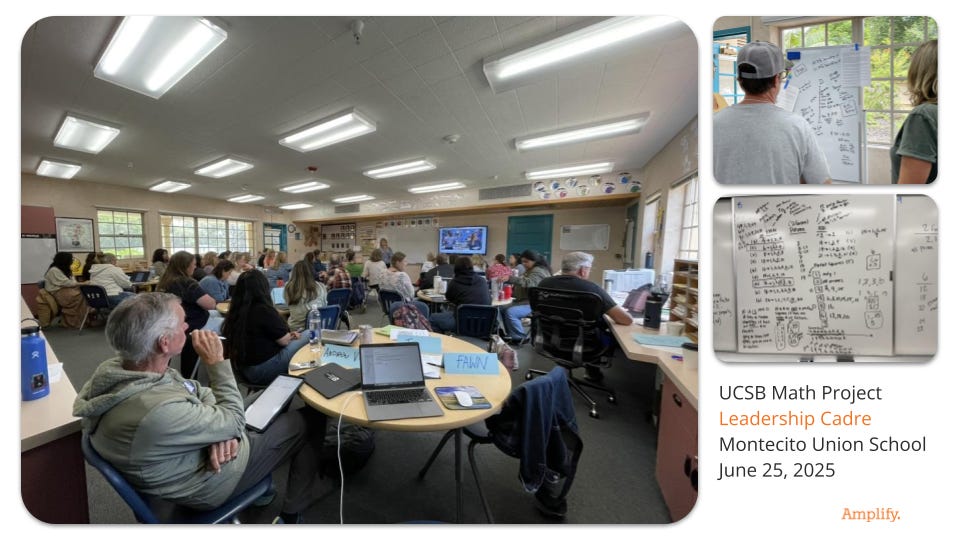
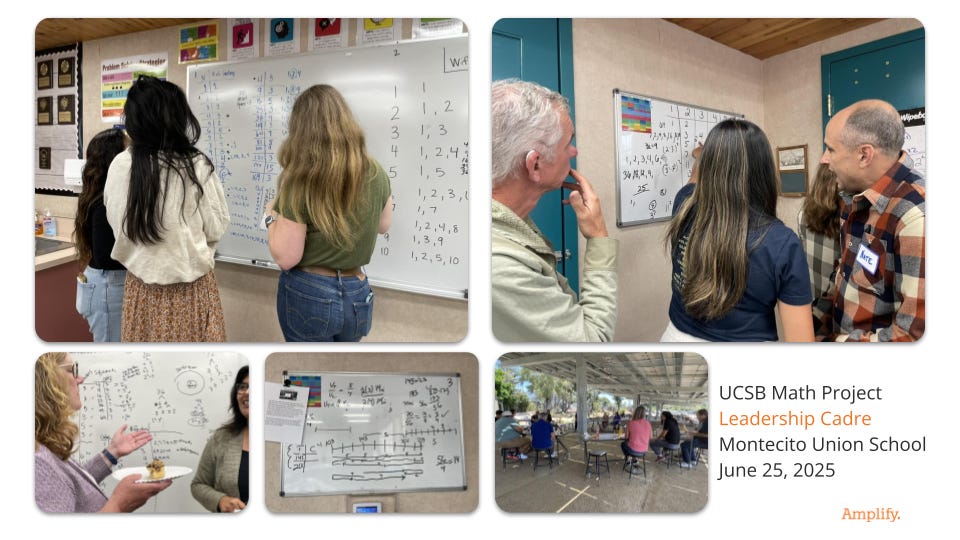
These pictures are from the summer institute this past June. The demand was so strong that we had a waiting list—and ultimately accepted five more teachers than we'd originally planned. You can see teachers fully engaged in math tasks at the whiteboards. We had lunch together outside among the chickens and goats that roam the school grounds.
Here's what one teacher wrote after four days with us:
What I realized this week is that I was great at memorizing formulas and never really made sense of what that work meant in context. This lack of understanding showed in the math classes I have taught as an educator; even with the youngest students, I struggled to find meaningful ways to embed number sense concepts with our school's chosen curriculum. In four days, you all have planted a seed that transformed my math identity, and probably my mindset overall. My love for math has been reignited by the idea that problems can be multi-faceted and solutions flexible. … All I can think about is if this happened in just four days for me, I can't wait to see what will happen to my students in the next 10 months.
I’m full time at Amplify, yet they've allowed—and encouraged—me to continue with the UCSB Math Project. My Amplify commitments come first, but when scheduling conflicts come up and I need to be at a workshop, I've always been allowed to go. My manager's last response was, "Of course, Fawn... you are doing important work." I'm grateful to be at a company that values and supports this.
I’m proud to be part of the UCSB team. It’s the mutual trust and respect among colleagues that allows us to do the hard work and actually thrive. PD is costly, important shifts in math education move at molasses speed, but there are enough of us who are passionate about continuing to make a difference. Please don’t hesitate to reach out if I can answer any questions about our work.
You just can’t have Rachel Lambert. She’s ours.
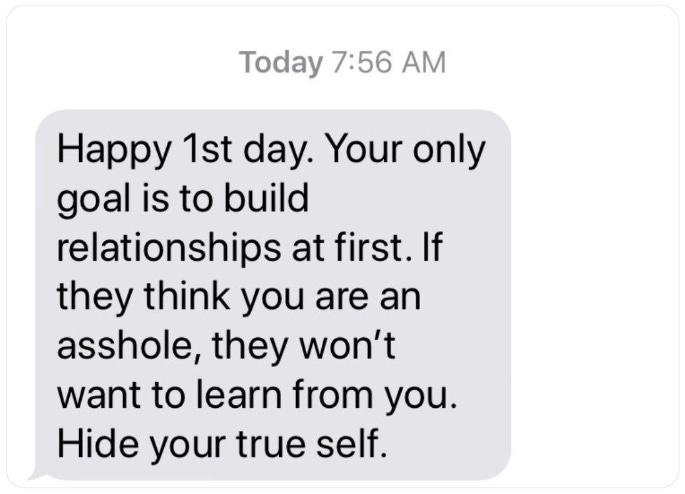
Jeff, however—please take Jeff from us. He sent me this text:
I am so very proud of you and privileged to see this important work that you have been doing for a long time. Lucky are the teachers and the students. Kudos to the districts that support the teachers in this important learning and collaboration.