


This lesson is from MARS. Using graphics from the original source, I created this recording sheet.
But instead of handing out the worksheet like I’d planned, I put the stack in my desk drawer and asked students to follow my verbal instructions to create the diagrams.
Each student got one sheet of unlined paper and a compass. I followed along with them.
Here were my instructions:
Put a dot in the middle of the paper.
Draw a large circle centered at that dot.
Draw in the diameter.
On this diameter, mark halfway along the radius. (I didn’t ask them to bisect it formally—we just estimated with a ruler.)
Using that halfway mark as the center, draw two small circles along the diameter, each with half the radius of the original circle.
Shade the outside of those two smaller circles.
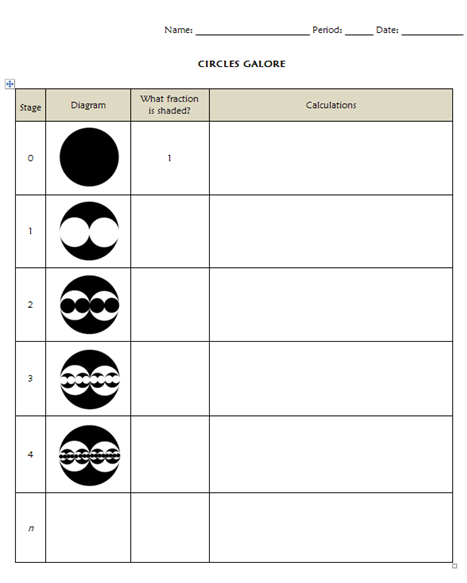
At this point, their drawings matched Stage 1 of the worksheet.
Question 1: What fraction of the large circle is shaded?
They got quiet and started working. When about half had finished, I said, “I know not everyone’s done, and that’s okay, but I’m going on with the next steps. Just follow along, and you can return to Question 1 later.”
I repeated directions 4 and 5—now placing smaller circles within each of the two smaller ones.
Before I even posed the next question, Josh asked, “What fraction is shaded now?”—and they were off again.
We repeated this process to create Stage 3, though our compasses couldn’t make circles smaller than a 0.5-inch radius, so we freehanded from here. Then came:
Question 3: What fraction is shaded?
Josh again: “Are we doing this again? Making even smaller circles?”
Yep. Stage 4 included the next 16 shaded circles.
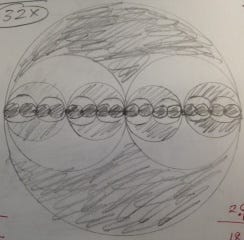
Question 4: What fraction of the large circle is shaded?
I asked them to work independently for now, but let them know they’d have time to discuss in the last 15 minutes of class. They stayed focused and plugged away.
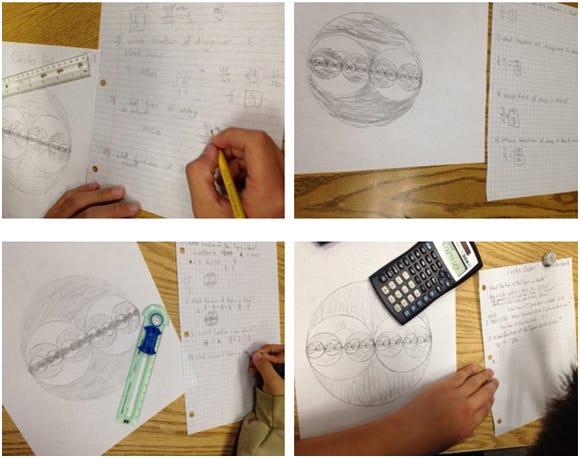
Then the talking started—a lot of it. I started recording some conversations, especially from students who didn’t get 1/2 for Question 1.
Zach told his classmates the answer was 2/π, explaining:
Did you catch what Zach said? He said, “You can’t get rid of stuff because we haven’t done any mathematical operation to get rid of π.”
I was thrilled this came up. Wrong answers like this are gold.
(Side note: Slater bluntly said, “That’s wrong.” Then came peer pressure. “He made me change my answer.” “Taj showed me the way.” I will miss this class.)
Daniel kicked off a discussion in another group.
His “formula” wasn’t written down—it was all in his head. Then I saw he’d calculated all the way to Stage 8. I was speechless.
Class ended. Everyone agreed the answer to Question 1 was 1/2.
I handed out the worksheet for homework, asking them to finish stages 2 through 4 if they hadn’t already, and to try Stage n if they had time. Daniel hadn’t even seen the worksheet, but he was already heading that way on his own.
We’ll finish the lesson tomorrow, but I wanted to write this down before the memory fades.
Some reflections:
When I search for lessons, I look at ones intended for at least a grade level above mine. I figure I can always scale it back.
I added “Stage n” just to fill space at the bottom of the worksheet. Daniel lit up when he saw it.
I’m glad I had them draw the circles from scratch—a last-minute decision that paid off.
My students are smarter than I am. (Let’s not tell them this.)
Daniel’s mental equation was so elegant.
Whether we reach Stage n tomorrow or not, I’m satisfied. That’s icing. I already feel full.
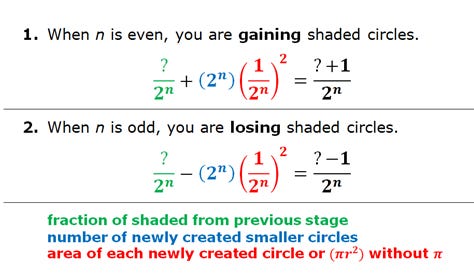
Speaking of Stage n: What do you think? Is there a limit we’re approaching?