


I don’t know what else to do except suggest that an anti–Common Core parent come and visit my classroom.
Visit for a period.
Stay the whole day.
Come back tomorrow.
Stay for a week.
Come back next month.
Become a parent volunteer in my room. Help me help a child — because God knows we all have students who could use one-on-one support.
Parents should be our allies. A few are a little… let’s say passionate. But that’s true for teachers, doctors, plumbers, and postal workers too. Parents love their kids. They want what’s best. They worry their children aren’t developmentally ready for Common Core. They’re afraid it’s one-size-fits-all, that it stifles creativity, that it’s the first step toward national curriculum and testing. The fears keep piling up.
Both sides are passionate, and it gets loud. I usually stay out of the noise because it drains me. The energy I give to that noise doesn’t return as anything useful. It just disappears, leaving me hollow and breathless.
But tonight, I’m talking by writing. It’s midnight. It’s quiet.
I want parents to observe their children doing Taco Cart and Always, Sometimes, Never. I want them to listen in on student math talks. I want them to walk in on a day I’m giving direct instruction — and see how much the kids direct their own learning, how much they’re trying to make sense of something new.
I want parents to observe you — my brilliant local and online colleagues, whose lessons I borrow and whose support makes me better.
So that’s my plan:
I will invite parents to visit my classroom any time they want. I actually prefer unannounced visits. Let them see a Common Core lesson in real time.
The worst that can happen? I fall flat.
But I guarantee their kid won’t.
I recently found some very old arithmetic textbooks at Open Library.
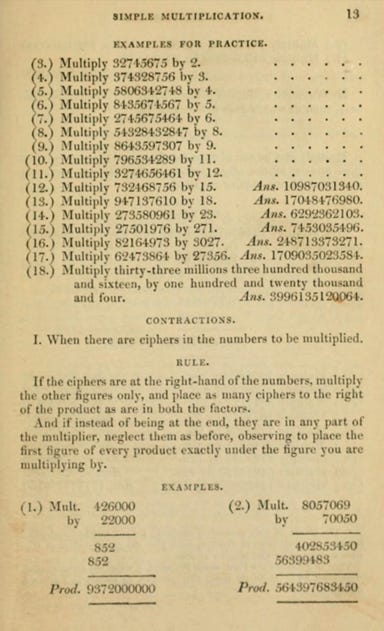
Here are a few prefaces that stood out to me:
From Adams, 1848:
Exertion, then, to bring teachers to a higher standard, will be more effective in improving school education than any efforts at improving school books can possibly be... Without the cooperation of competent teachers, the greatest excellences in any book will remain unnoticed, and unimproved...
From Colburn, 1862:
When a pupil, having left the school room, performs a problem of real life, how anxious is he to know whether his result is correct! Neither text book nor key can aid him now, and he is forced to rely on himself and his own investigations... If he must always do this in real life... ought he not to do it as a learner in school?
Besides, the labor of proving an operation is usually as valuable as the labor of performing it...
That said, some of these old division problems are bananas. And these were aimed at school-aged kids, grades 4–8.
From Walton & Holmes (1909):
408,903 ÷ 3,508
147,500 ÷ 6,190
From Thorndike (1921):
748,275 ÷ 825
42,974 ÷ 8,523
From Colburn (1862):
55,673 ÷ 6,349
2,700,684 ÷ 19,743
From Adams (1848):
46,720,367 ÷ 4,200,000
Reduce 468/1184 to lowest terms
From Bonnycastle (1843):
4,637,064,283 ÷ 57,606
Common Core looks pretty good next to that.