


The idea for this lesson comes from Measurement in the Middle Grades, published by NCTM in 1994. I created this worksheet for the activity.
I purposely didn’t give the kids interlocking cubes for question 1—I wanted to see if they could count the number of windows and rooms just from the diagrams. A few students had some trouble counting the windows in Buildings D and F.
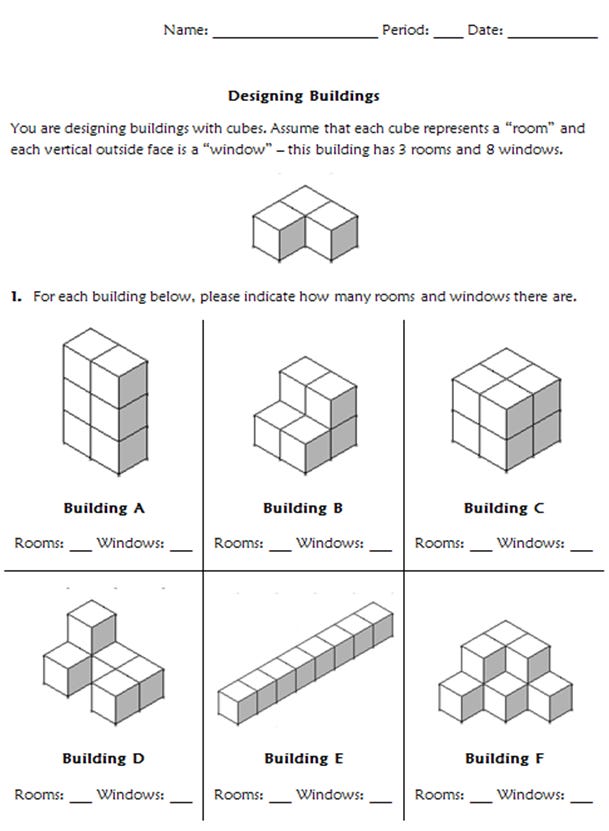
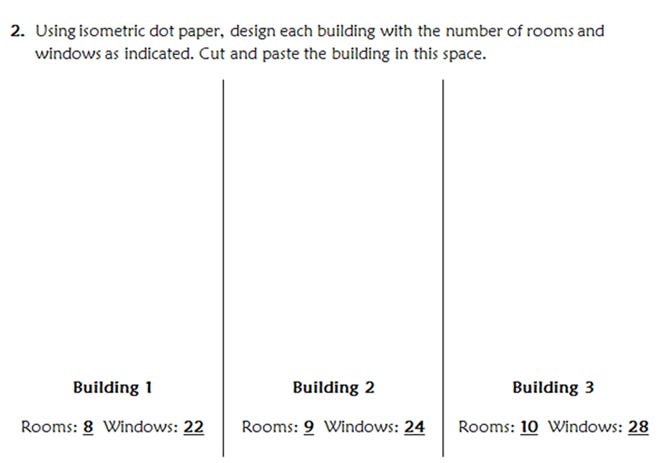
In question 2, students needed to create three buildings, each with a specified number of rooms and windows. I passed out interlocking cubes and isometric dot paper at this point.
While some kids could build a structure, they had a tougher time drawing it on dot paper. Rapha had a suggestion for us.
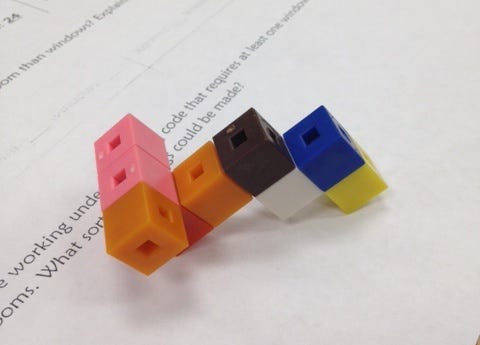
Matt built this and wanted to know if it could be considered a “building.” The class redefined it as “It’s a building if it can stand without tipping over.”
Before they drew their buildings, I asked them to hand theirs to at least one classmate to verify the correct number of rooms and windows. They were deeply engaged in constructing and drawing to complete question 2.
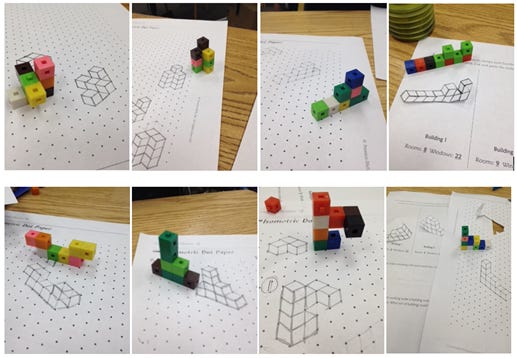
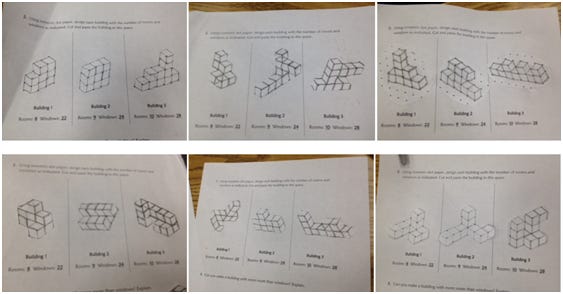
By the second day, at least half the class was working on questions 3 and 4.
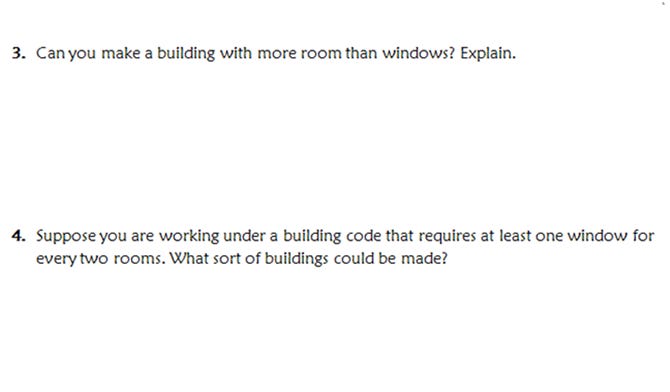
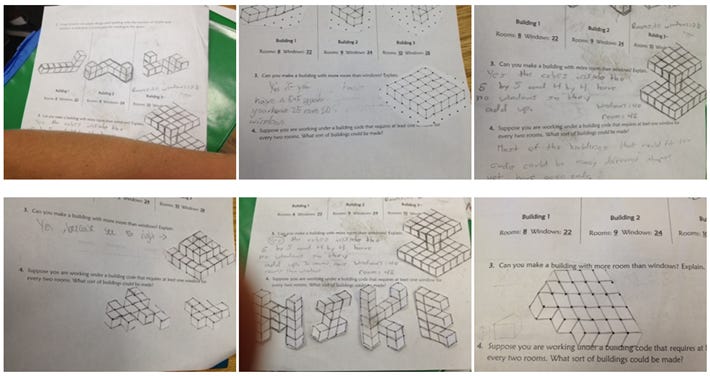
These were some of their responses to questions 3 and 4:
They were very much into the building and drawing, so I went around to ask them what they thought of this lesson thus far:
It lets me be creative by drawing and making, see how it comes out.
It’s difficult to count the windows. I check with my classmate and it’s wrong!
This is awesome fun, question 4 is challenging, I’m still trying to figure it out. I’m stuck on creating Building 3, it’s difficult, but I’m pretty close.
I like the different ways that I can build.
I never thought question 3 would make me think so hard like this!
Drawing is easy for me, it’s more difficult to build.
The 3-D drawing got easier after Rapha helped me.
It’s difficult. It’s not working out (referring to creating Building 2), but it’s fun to try to find it.
Very fun, I like it because I can help people with it, show them how to draw perspective.
My conversation with Sam about his paper:
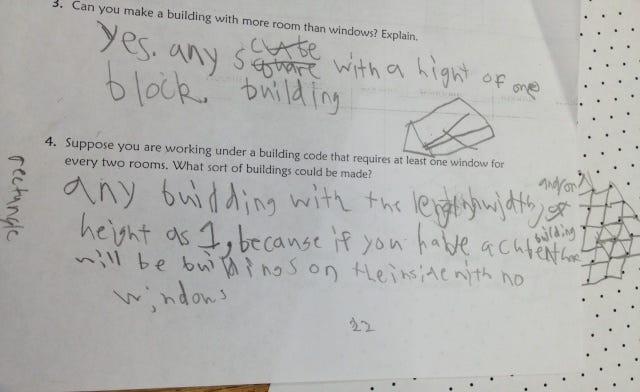
Me: Help me read your answer to question 4.
Sam (reading aloud): Imagine a gigantic cube building… Well, all those rooms on the inside don’t have windows. So, no passing the code!
Me: How big is “gigantic”? What size?
Sam: Hmmm… 25 cubes on each side?
Me: Okay, like 25 by 25 by 25.
Sam: Let me get a calculator.
Class was ending. I asked them to finish this for homework. A few students asked to take some cubes home, so I let them.
I look forward to Sam’s calculations for his “gigantic” cube building. And I look forward to our class discussion tomorrow—I’ve never heard both “fun” and “difficult” used to describe a lesson as often as I did during this one.