


Thanks to Dan Meyer for this great task idea on equilateral triangles.
Act One asks us to rank how well each teacher drew their equilateral triangle.
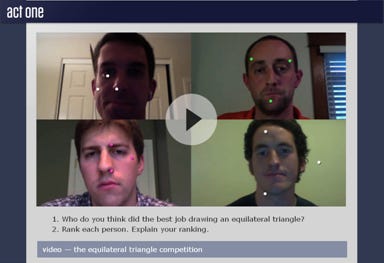
As soon as I saw the video, two thoughts came up:
We’re in a 0:1 classroom right now, and having the whole class come up to the big screen just isn’t efficient.
I want to be in the competition! And the kids will definitely want in, too.
So this had to be a pencil-to-paper activity.
Eyeballing
Instructions to my 8th-grade geometry students:
“Here’s a blank sheet of paper. Sharpen your pencil. Put your name in the upper-right corner.
Using only your eyeballing skill and your pencil, mark three dots in the shape of an equilateral triangle.”
Liam—who usually asks thoughtful questions that make my heart sing—asked, “So… you want us to draw the best equilateral triangle?”
“No, Liam. I want the crappiest one you can draw.”
“Now connect the dots with a straightedge. Pass your papers forward—I’m going to make a photocopy in case we mess something up.”
While I dashed to the copy room, I told them to think about this question:
How are you going to decide which triangle is the most equilateral?
(And please don’t tell anyone I left the class alone for three minutes.)
Testing for Equilateralness
Back in the room, I randomly passed the papers back—everyone got someone else’s triangle.
“Write your name as the ‘tester.’ Now… what makes a triangle equilateral? What’s our scoring system? Talk to me.”
They said:
It should have three equal sides.
Or three 60° angles.
“Great. So you’ll be measuring sides and angles. That gives you six numbers. Do you need all six? What will you do with them?”
We know what perfection looks like. But no one’s triangle is perfect—so how far off are we? What score does it get? And how fair is your method?
“Work quietly by yourself for now. Use your ruler, protractor, compass, calculator—whatever you need.”
Working Alone
They worked diligently. One student used her ruler to extend a side so she could measure the angle more accurately.
Ella asked, “Centimeters, right? To the tenth?”


Working in Small Groups
I randomly grouped them into threes.
“Share your scoring strategies. Fight about it. Defend them. Then pick the best one to present.”
Also: “Just because someone in your group drew a wobbly triangle doesn’t mean their method is bad.”
I added, “Should a larger triangle get more points? Is it harder to eyeball dots farther apart?”
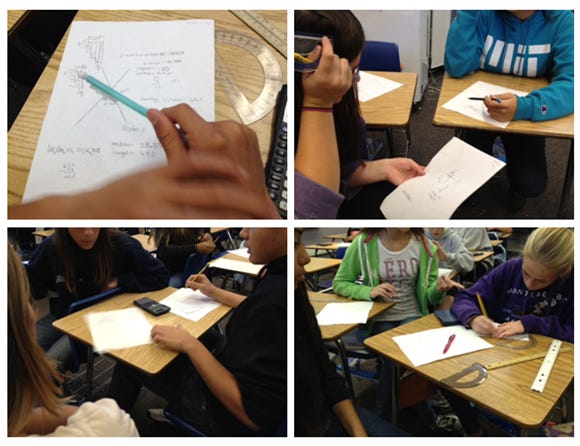
I floated around, listening and asking questions. Didn’t want to be anywhere else.
Presenting to the Class
They were eager to share. They questioned each other:
“Why divide by 3?”
“Why 100 points?”
“Why that formula?”
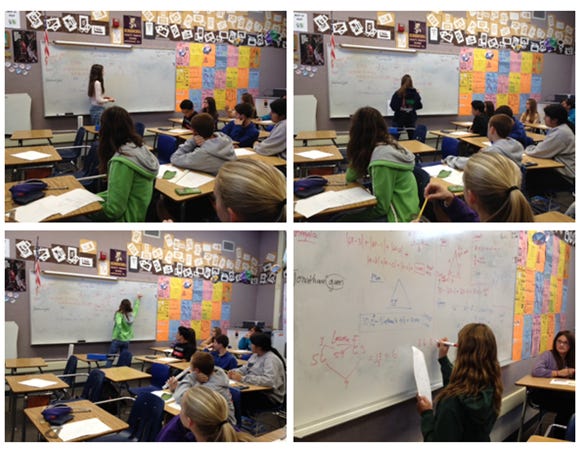
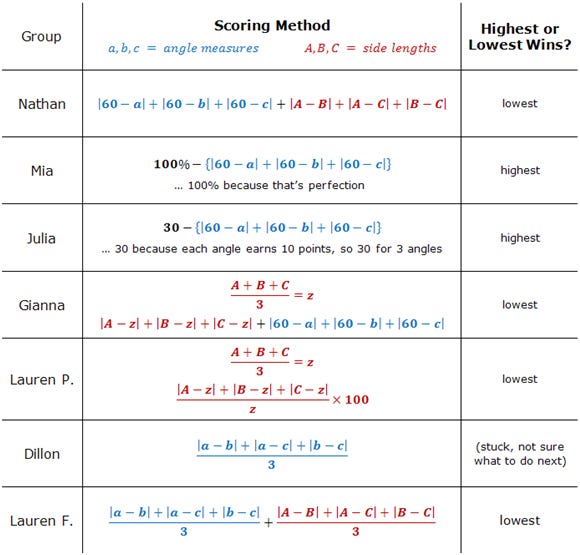
We wrote summaries of each group’s scoring method on the board. Four of the seven groups used only side lengths or only angles, not both.
Voting on the Best Method
The method from Gianna’s group got the most votes—with 9.
Nathan volunteered, “None of these is spot on. But I don’t know what the best way is either.”
I said, “Thanks for saying that, Nathan. Me neither. But I love what you’re all coming up with.”
No one brought up perimeter or area. I vowed not to say anything—I wanted them to drive this.
Okay, Gianna’s famous now. We’ll call her group’s method Gianna’s formula from now on.
Testing Again
I made another set of copies and passed them out randomly.
“Apply Gianna’s formula to this new triangle.”
That way, each triangle got tested by two different students.
They recorded results on the board.


About 7 of the 20 had enough discrepancy that I asked both scorers to recheck their measurements. I then took the average.
The Results
I went back and measured all the original triangles myself, then used Dan’s calculator.
[Chart here]
Names in yellow matched Dan’s and Gianna’s formulas exactly. Green was off by just one rank.
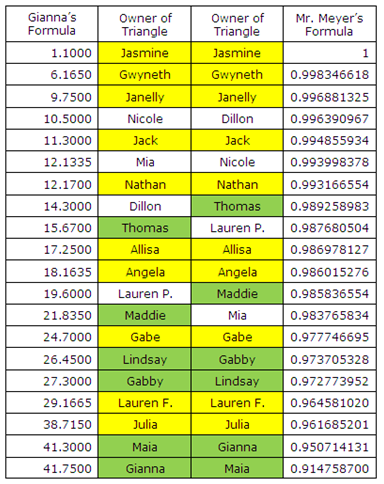
We thought this lesson was pretty great.
Maia said, “Our way was not too bad at all.”