


I show my 6th graders this image, pointing out that it represents the two numbers 1 and 1 that I entered at the top.

Then I ask them to give me two new numbers—any two positive integers (10 or less, for now)—and the computer generates a new picture. With each new pair, students jot down their "I notice, I wonder" in a Google Form and draw a rough sketch in their journals. After a few examples, I ask them to predict the next image before I reveal it.
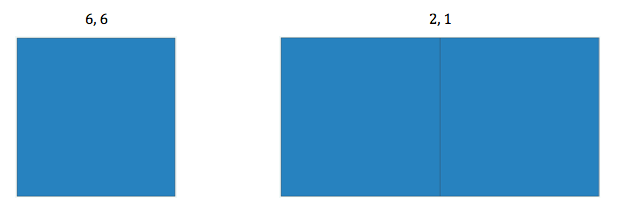
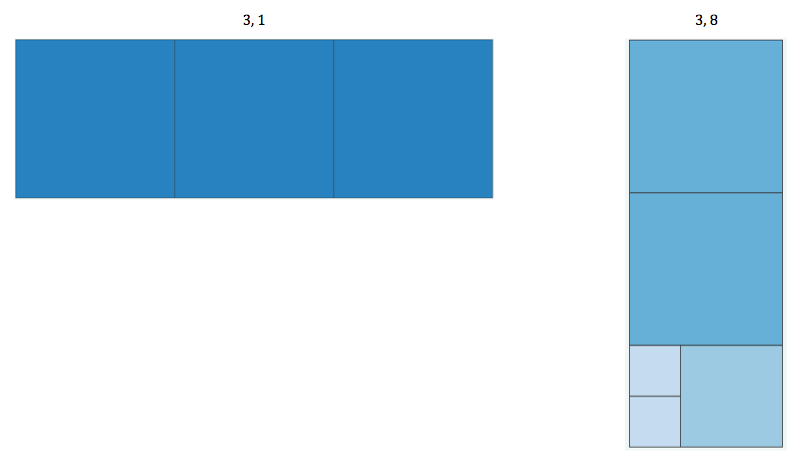
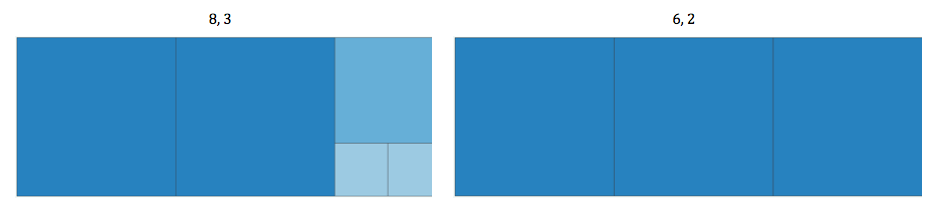
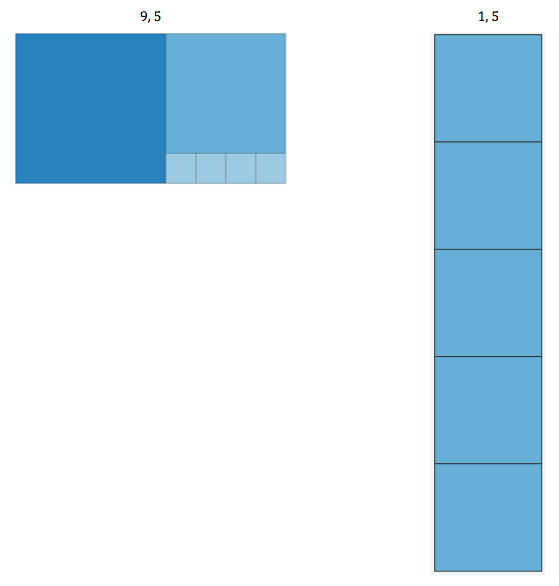
Here are the number pairs they requested, in order, and the pictures that followed:
I love that the kids are asking for…
6, 6 after 1, 1
3, 8 after 3, 1
8, 3 after 3, 8
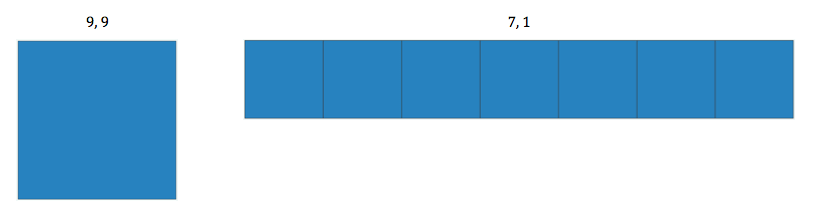
Then, near the end, someone calls out 9, 9, and another asks for 7, 1. That’s when I shift the tone.
“Okay,” I say. “What if figuring out this puzzle—how the computer draws the picture from two numbers—earns you a million dollars. But each sketch request costs money. So, ask carefully. Let it test your conjecture.”
They lean in.
A normally quiet student says, “10, 3.”

Another: “What does 100, 5 look like?”

“Great,” I say. “But for 8, 5—sketch it first, then I’ll reveal it.”
They share drawings with a neighbor. No one’s matches.
I ask, “Do you think yours is more correct than your neighbor’s?”
I show them the actual image for 8, 5.

Then, 23, 75.

Some of what they wrote (with light edits):
“When we used the same two numbers, the shape didn’t change. But different numbers changed the picture.”
“Why does 3,8 divide into parts inside a square?”
“I notice that if the numbers are the same, it’s one square. I wonder if the two numbers are dividing to make the shape.”
“The smaller the parts are, the lighter the shade of blue.”
“My drawing for 8,5 had one big square and 5 little ones.”
“When we did 3 and 1, it gave 3 ones—so maybe it just divides the first by the second?”
They’re full of ideas—partial understandings, big questions, and confident wrong guesses. It’s beautiful.
Then, together as a class, they come up with:
When both numbers are the same, it’s one square.
The computer simplifies the two numbers. So 6, 3 looks like 2, 1.
If the second number is 1, the diagram shows that many squares (e.g., 7, 1 → 7 squares).
The first number is the horizontal dimension; the second is vertical.
They’re all squares.
The dismissal bell rings, and I want to teach forever.
Tomorrow we’ll pick one set, like 10, 3 or 8, 5. We’ll dissect the diagram, explore more, sketch more. We’ll write the equations that match. I’ll guide them to notice how the smallest square relates to the original numbers.
I found this investigation on Underground Mathematics. They describe themselves as providing “rich resources for teaching A level mathematics.” From what I understand, “A level” means advanced high school math—quadratics, logs, sequences, calculus.
Perfect for my 6th graders, who torment me with things like 3² = 6 and 5 ÷ 10 = 2.
The original task is written for older students, but I found what I needed to make it rich and accessible for mine.
Hail, Euclid's Algorithm.