


A few days ago, Mary replied to Nat’s tweet:
@fawnpnguyen is the queen of this. Pretty sure she has a blog post on it.
— Mary Bourassa (@MaryBourassa)
God, I love Mary. She once mailed me a decadent chocolate bar from 2,800 miles away. She remembers my birthday — which is more than I can say for two-thirds of my children.
But no, I didn't have a blog post on adding fractions — not until now.
Surely, I thought, there must already be a bunch of videos on using rectangles to add fractions. But the first two I clicked on? Both used grid paper… without using the grid. Like, what the heck?
Let’s walk through an example using rectangles.
Say we want to add:
2/3 + 4/5
Start by drawing two same-size rectangles — using the denominators as dimensions.
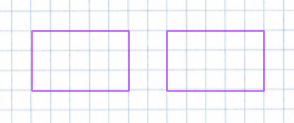
Students will ask, “Why 3 by 5?” If they don’t, you ask why. Then ask them to shade in 2/3 of one rectangle and 4/5 of the other.
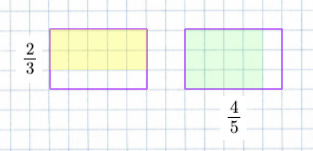
Give them a few seconds — the 3×5 setup will start to make sense. You’ve got a rectangle with both denominators built in.
Addition
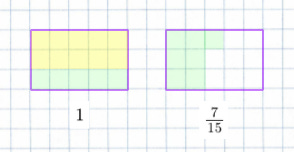
Since we’re adding, we combine the shaded regions — keeping the rectangle size consistent:
Subtraction
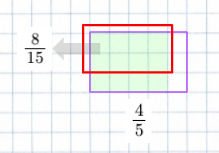
Works the same way. Shade both fractions using a shared rectangle, then subtract one region from the other.
Still visual. Still fraction sense. Still clean.
Multiplication
Here, the word “of” becomes key.
To find 2/3 of 4/5, we draw a 5-by-3 rectangle. Why? Because thirds and fifths are built into the height and width. Then:
Shade 4 out of 5 columns
Then take 2 out of 3 rows within those columns
And bam — you’ve got the product visually.
To do 4/5 of 2/3, just switch the lens. Shade 2 of 3 rows, then take 4 of the 5 columns from that.
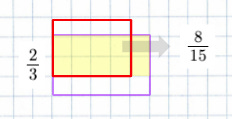
Yes, commutativity still applies — but the perspective changes.
Division
I’ve written about this before: