


I'm always happy to hear how teachers are using visualpatterns.org with their students.
Michael Fenton shares how he uses the patterns with Desmos.
Alex Overwijk’s students use big whiteboards.
Bridget Dunbar removes some figures so kids have to draw them in.
Kristin Gray uses them with her 5th graders.
I do visual patterns with my students every Monday as part of our warm-up routine. I’ve already shared 28 pattern talks (and 28 number talks) on mathtalks.net (no longer available), but I want to share a couple more here because my 6th graders have made incredible gains in seeing patterns in different ways—and in articulating equations to go with each one.
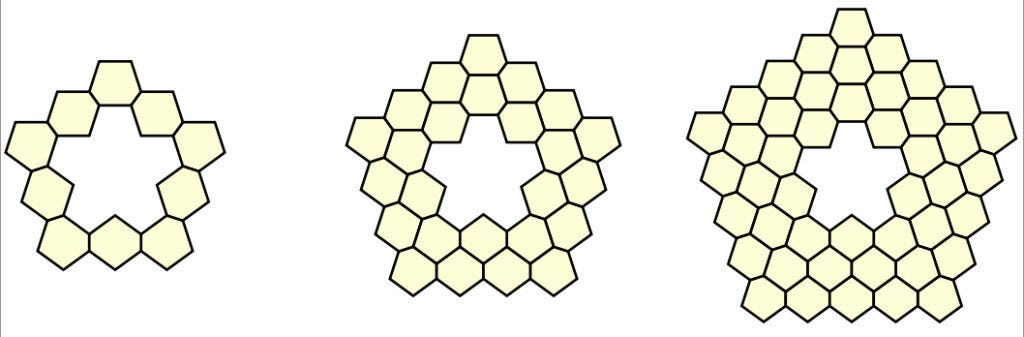
Pattern #153
I originally meant to use this with my 8th graders, but my printer failed, so I used it with my 6th graders instead. Turned out to be a fun challenge!
Student 1:
I see five spokes coming out. Each one has n hexagons. In between these five are Gausses.
So the equation is five times n, plus five Gausses.
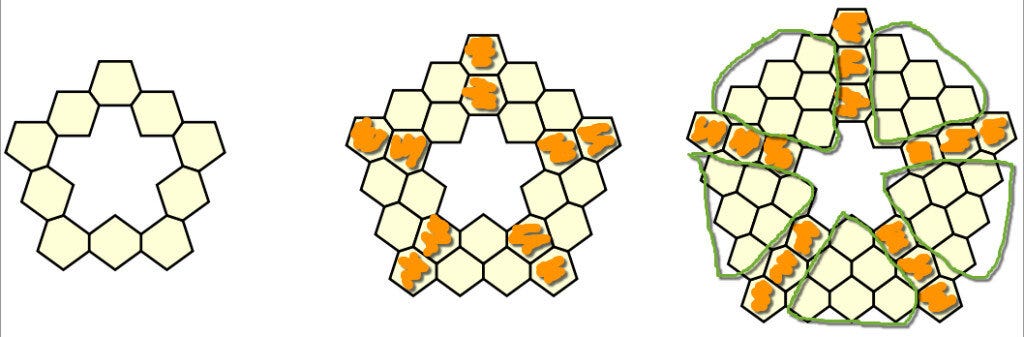
Their equation:
Hexagons = 5n + 5(1 + n)(n/2)
Over time, my students have come to recognize Gauss addition really quickly. They use Gauss as both a verb and a noun—as in, "I Gaussed it" or "I saw two Gausses in the pattern."
Student 2:
Each step adds a ring of hexagons around the outside. In the outermost ring, I see three groups of (n+2), plus a leftover.
The leftovers are odd numbers. So the outer ring alone is:
3(n+2) + 2n - 1
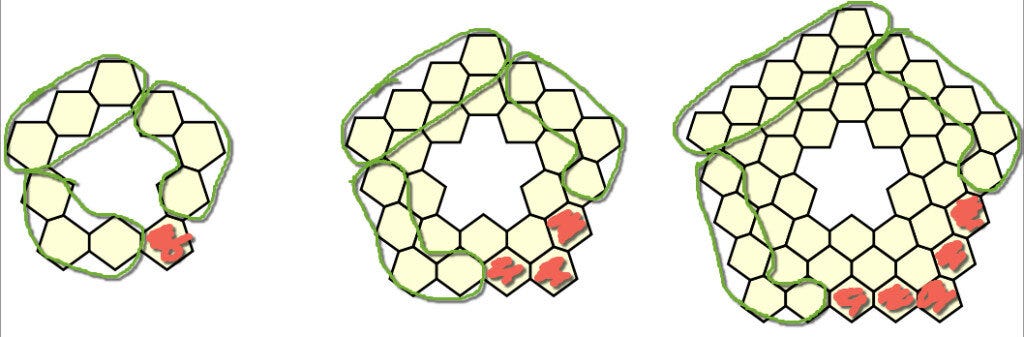
We talked through each part to carefully write this full equation:
Gauss means adding the first and last terms, then multiplying by the number of pairs.
The first ring is always 10.
So: 10 + 3(n+2) + 2n - 1
Both equations simplified to the same result:
Hexagons = (5n² + 15n)/2
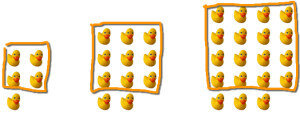
Pattern #147
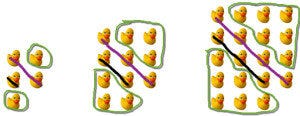
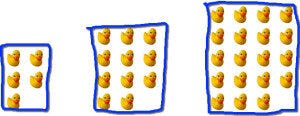
I’m sharing this one because of how many different ways kids approached it. In my class, if someone already shared the way you saw it, you have to come up with a different one.
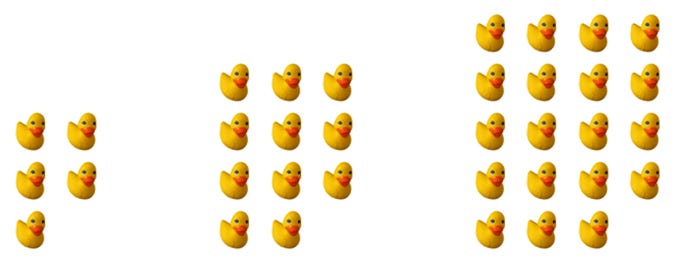
Here are just some of the student equations:
Ducks = n² + (2n + 1) + n
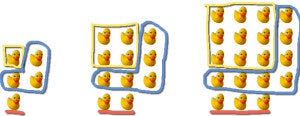
Ducks = (n + 1) + (3 + 2n + 1)(n/2)
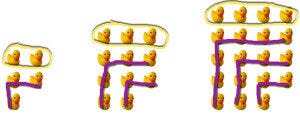
Ducks = n(n + 2) + (n + 1)
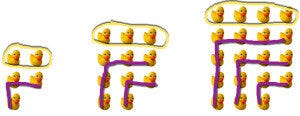
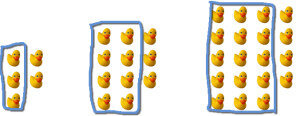
Ducks = 2(1 + n)(n/2) + (n + 1) + n
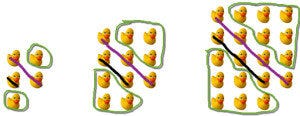
Ducks = (n + 1)(n + 2) - 1
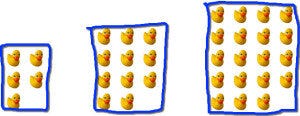
Ducks = (n + 1)² + n
I very intentionally do not have kids fill in a table of values for visual patterns. I'm afraid it becomes their starting point every time instead of just looking at the structure of the pattern itself.
Our 8th graders, who use CPM (which I really like), get plenty of chances to work with tables, graphs, rules, and sketches. But these are my 6th graders—and they’re writing quadratic equations without all the fuss right now.
Please continue to share the site. What I love most is learning that the patterns get used in elementary and high school classrooms.