
Would you have known immediately that the number 1729 is the sum of two cubes?
Ramanujan told Hardy that 1729 is the sum of two cubes in two ways:
1³ + 12³ and 9³ + 10³
I read The Man Who Knew Infinity a few years ago.

Also, I subjected my students to this 14-minute podcast about Hardy and Ramanujan.
One more "fair share" task for my 8th graders from Peter Liljedahl’s site. I like it, and I’m definitely not touching the textbook this week because of state testing.
Joint Investment
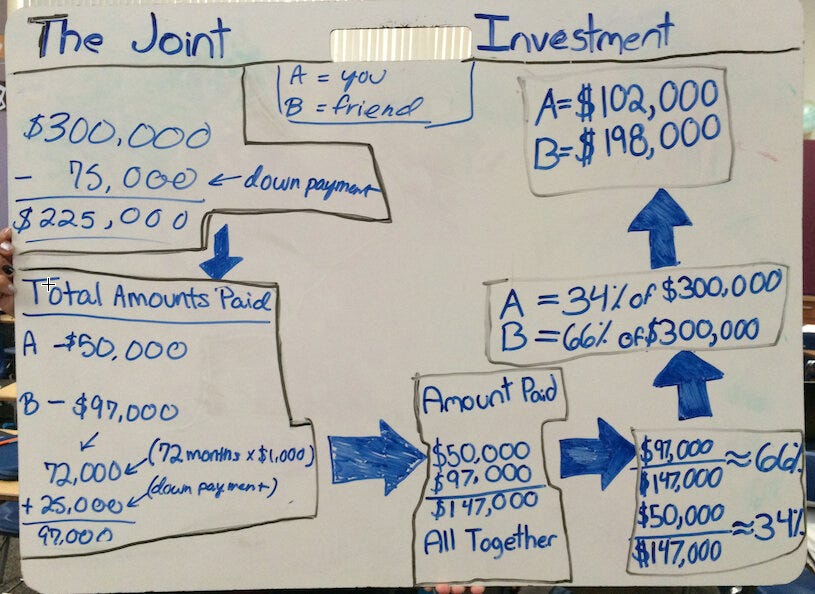
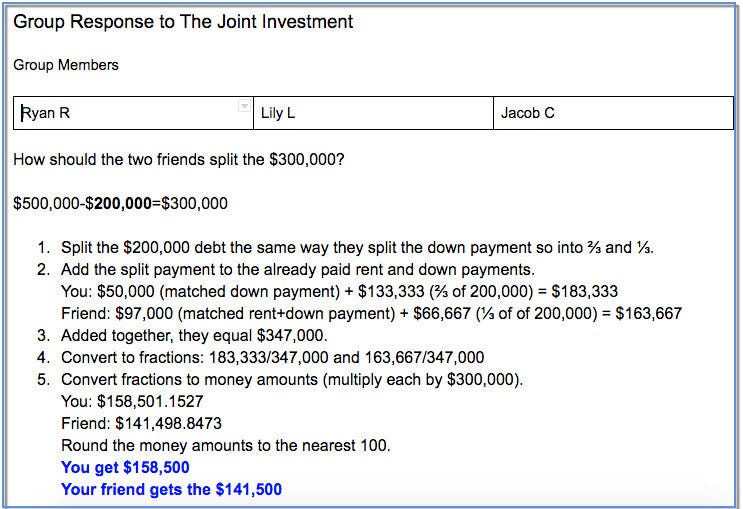
Six years ago you made an investment with a friend – you bought a house together. It wasn’t only an investment, it was also a favor. Your friend didn’t have a place to live and didn’t have enough money to buy a house. So, you pooled your money and bought a $300,000 house for your friend to live in. You provided $50,000 for the down payment and your friend provided $25,000. Because of the size of the down payment it meant that the mortgage was relatively low – only $1000 a month – which your friend paid. During the six years all property tax payment were split evenly between you as were all major renovations and upgrades. Well, it is now six years later and your friend is getting transferred to Ontario. So, you have sold the house for $500,000 (the market has been good to you). There is still $200,000 outstanding on the mortgage. How will you split the $300,000 equity between you? Justify your decision.
Two groups of students have submitted their solutions so far.