


Last Monday morning, I was on a SuperShuttle from SFO to the Creekside Inn. I was running late, so the driver dropped me off directly at the American Institute of Mathematics (AIM). I was expecting a tall, glassy building. Instead, we pulled up to… this.
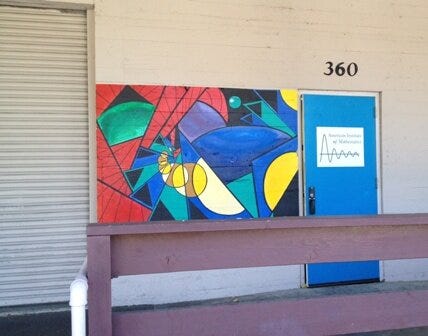
I was searching for a Math Teachers’ Circle to join, hoping to find a local group where I could collaborate and grow. There wasn’t one nearby. So I looked into what it might take to start one.
I asked Erin, my next-door math colleague, if she’d be interested in teaming up. That gave us the two middle school teachers we needed. We still had to find two mathematicians and one administrator or organizer to complete the team.
I reached out to Brianna Donaldson, Director of Special Projects at AIM, and within a week she connected us with Nate and Hala, both math professors at Cal Lutheran. For our fifth member, I asked Melissa, the third person in our tiny junior high math department, and she agreed to join.
Our team was selected for full funding to attend a one-week workshop in Palo Alto on how to launch and sustain a Math Teachers’ Circle.
Here’s a summary of that week—what we learned, what we planned, and how it shaped the work we did next.
Monday
We meet Nate and Hala for the first time. They look exactly like their photos.
There are six teams in total: two from Texas, one from Kansas, one from Rochester, NY, and two from California.
Josh Zucker opens the week with a session titled “Introduction to Problem Solving.” I’ve wanted to meet Josh for years—his name is attached to many of the beautifully crafted problems I first encountered through the Julia Robinson Mathematics Festival. As it turns out, he’s the director.
He gives us this gem:
The numbers 1 through 100 are written on a board. You choose two numbers, x and y, erase them, and write xy + x + y in their place. Repeat until one number remains. What are the possible final values?
Three constants define each day:
Two-hour lunches. The nearest restaurants are a 15-minute walk.
Afternoon logistics time, where we work on our Circle plan—funding, structure, location.
Happy hour. Every day. Optional, technically.
Tuesday
Tatiana Shubin (San Jose State) presents “Grid Power.” I already have my students using graph paper for notes—now I want them doing all their math on it.
Problem: How many squares are there in a 7×7 square?
Paul Zeitz follows with “Mathematical Games.” He’s a math professor at the University of San Francisco and, as I realized later, the author of The Art and Craft of Problem Solving—a book I’d always wanted but didn’t connect to him until after the workshop. Instead, Paul recommends Solve This by James Tanton.
We explore two games with Paul:
Takeaway: 16 pennies; remove 1–4 each turn; last to move wins.
Puppies and Kittens (also known as Wythoff’s Nim): remove any number of one type, or an equal number of both.
Paul introduces a brilliant method of tracking wins and losses as “oasis” and “desert” points—on a line for Takeaway, on a coordinate plane for Wythoff’s Nim.
Wednesday
Diana White (University of Colorado Denver) leads us through Exploding Dots—a creation of James Tanton.
A machine holds ping-pong balls. Three balls in a slot “explode” and two move one slot to the left. Repeat until fewer than three remain.

Starting with 9 balls, you end up with…

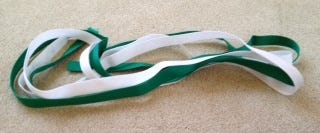
Tom Davis, a retired math professor, shares Conway’s Rational Tangles—a physical tangle-and-untangle activity involving four students and two ropes. The students follow “twist” and “rotate” commands, which somehow correspond to operations on rational numbers.
Thursday
Paul Zeitz returns with “How to Gamble If You Must.” We explore dice games and this:
Two Lottery Tickets: A ticket costs $1. What’s the expected value based on different prize scenarios? Does the state profit?
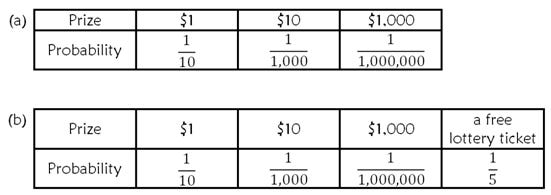
The goal: compute the expected value to the penny.
Friday
No math today. Each team presents their Circle plan in a 10-minute slot. We get T-shirts, take team photos, and say our goodbyes by noon.
I’m deeply grateful to everyone who made this workshop possible. And I love my team.
I’ve never had so much wine in one week. I brought home two corks to practice a trick Josh showed us. We’ll be launching the Thousand Oaks Math Teachers’ Circle, and I’m working on the website.
If you’re a teacher or a mathematician, consider joining—or starting—a Math Teachers’ Circle. We owe it to our students to make math accessible, joyful, and worth doing.