


From a set of playing cards numbered 1 through 9, I draw five cards and get 8, 4, 2, 7, and 5. I ask my 6th graders to make a 3-digit number and a 2-digit number using all five digits, aiming to get the greatest possible product. I add, “But do not complete the multiplication — meaning don’t actually compute the product. I just want you to think about place value and multiplication.”
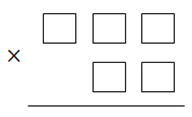
I ask for volunteers who feel confident in their two numbers to share. This question brings out more than a few confident thinkers — each one convinced they had the greatest product. (And for the record, I wasn’t entirely sure myself what the largest product would be. After the lesson, I asked some math teachers the same question, and I appreciate the three who responded. None of them got it right.)
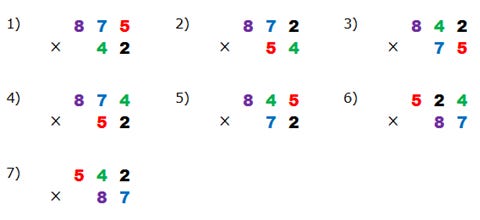
I tell the class, “Well, this is quite lovely, but y’all can’t all be right.” I ask everyone to look at the seven “confident” submissions and see if they can reason whether one product might be greater than another. Maybe we can narrow things down a bit.
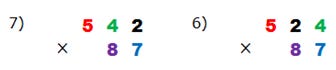
Someone quickly spots that #7 is greater than #6, and the class agrees.
Another student says #7 is greater than #1 because of doubling. She explains, “I know this from our math talk — doubling and halving. Look at #1. If I take half of 875, I get about 430. If I double 42, I get 84. Both of those numbers [430 and 84] are smaller than the ones in #7. So I’m confident #7 is greater than #1.”

Someone else reasons that #5 is greater than #4 by rounding: “Eight hundred something times 70 is greater than eight hundred something times 50. The effect of multiplying by 800 is much more.”

Another student chimes in, “Number 2 is also greater than #1 because of place value. I mean, the top numbers are almost the same, but #2 has twelve more groups of 872.”

But the only one the class unanimously agrees to eliminate is #6. I then ask them to take 30 seconds to quietly examine the remaining six and put a star next to the one they believe yields the greatest product.
These are their votes.
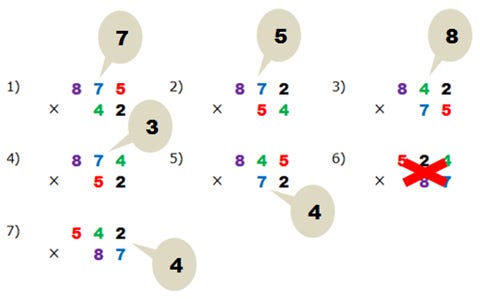
I tell them, “Clearly this is tough to think about — and that’s okay. That’s why we’re doing this.” We’ve done enough 2-digit by 2-digit multiplication during our math talks; now it’s time to up the challenge. #3 gets the most votes.
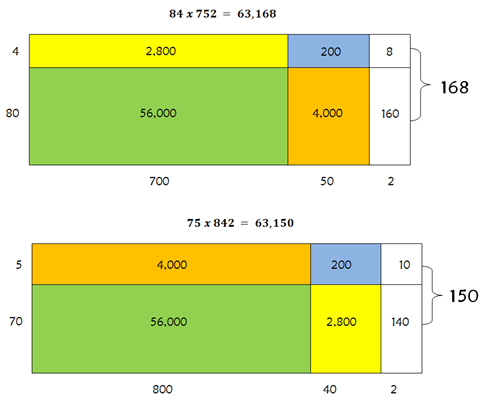
I punch the numbers into the calculator. The kids are practically vibrating with excitement as I press ENTER after each one. Cheers and groans ripple around the room. Turns out, #3 does have the greatest product — 63,150 — out of the ones we tested.
Ah, but then someone suggests 752 × 84.
I type it in. Gasps.
63,168.
Their little heads are exploding.
For homework, I give them a new set of five digits: 2, 3, 5, 6, and 9. Their task is to figure out the greatest product they can make with a 3-digit × 2-digit multiplication.
They come back with 652 × 93.
The next day, we try another set: 3, 4, 5, 8, and 9. The greatest product comes from 853 × 94. There is even more sharing, arguing, and reasoning than the day before.
Many students begin to spot a pattern in digit placement and are eager to share.
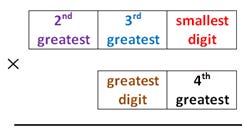
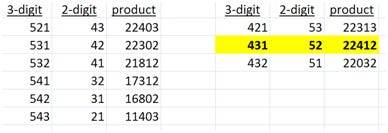
They agree that the greatest digit needs to be in the hundreds place of the 3-digit number or in the tens place of the 2-digit number. We use a simpler set — digits 1 through 5 — and agree that there are only 9 viable candidates to test. The same logic holds.
Then we draw generic rectangles to reinforce that we’re just looking for two dimensions that give the largest area.
I remember telling them more than once, “This is hard to think about.”
To which Harley, sitting in the front row, says, “But it’s like we’re playing a game. It’s fun.”