


For someone who’s openly admitted to not following curriculum pacing guides, I sure spent a ridiculous amount of time churning one out.
Our middle school is adopting CPM Core Connections 1, 2, and 3 this year. Aside from our own reviews, the decision to go with CPM was also based on:
The fact that Desmos is embedded in many lessons
Solid reviews from other teachers, including Riley Lark
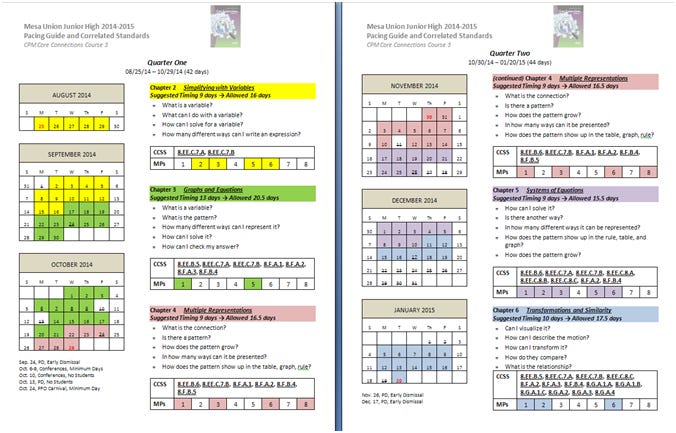
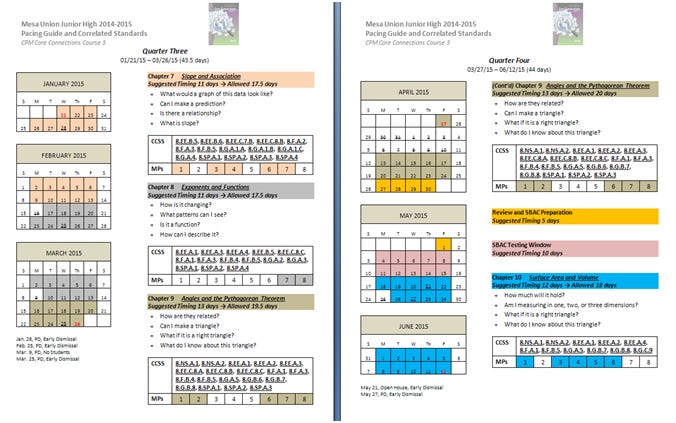
I replicated our school calendar, including all holidays and half-days. Then I went through each CPM chapter and wrote down the guiding questions. Matching the standards to each chapter? Total pain in the ass. CPM does it backwards — they list the standards first, then which lessons hit those standards. I prefer seeing it the other way around.
Also, the suggested number of days per chapter doesn’t include assessments, so I added about six extra days on top of whatever CPM recommended. I’ll probably print this pacing guide in full color — likely the only doc I’ll print in color all year — and tape it near my desk.
(Yes, I removed Chapter 1 because it’s on problem solving. C’mon. I got this.)
Then I’ll supplement the heck out of it. I just can’t teach straight from a textbook. So those six added days? They’re for wiggle room — to do all the “other stuff.”
Other stuff includes everything listed in the sidebar of this blog: math talks, rich tasks, classroom routines.
We also need time to begin each class with math talks, because that was one of the most powerful things we did last year.
(Grrrr... just realized most of the images on the math talks site are missing now. Why now.)
I was brainstorming warm-up ideas with a couple of 6th-grade teachers in a neighboring district. Here’s what we came up with for a weekly routine:
Monday: Number talk
Tuesday: Visual pattern
Wednesday: Estimation 180
Thursday: Fun fact, Would You Rather, Keeping Skills Sharp, or SBAC/review question
Friday: Personal reflection
My assignment this year looks almost the same as last year:
Two sections of Math 6
One section of Math 8
One section of Geometry1
I wish you a healthy school year.
Teach what you love and love the kids.
Follow the rules — but break a few if it makes things better for the kids.
I'm happy to say we’re no longer tracking students in math. But we’re finishing what we started with this group of 8th graders who took Algebra in 7th. This year will be a mix of geometry, statistics, and a whole lot of problem solving.