


Bleh. I don’t know of a clever way to teach parallel and perpendicular lines.
I’ll try asking kids questions, and maybe their answers will guide me and make me look smart until 2:50 p.m.
Me: Using your arms, show me parallel lines.
They do. One boy clasps his hands together like he’s praying.
Me: What do you know about parallel lines?
Students: They don’t touch. They don’t intersect. They don’t meet.
Me: Okay. Please draw this line in your journal—we’re all drawing the same one. Make sure yours passes through the points (0, –2) and (4, 0). Now, draw another line that runs parallel to the first.
I walk around the room. Most of them have drawn pretty good “parallel” lines—not perfect, but close.
Me: How are you going to convince me that you drew parallel lines?
Silence. One kid raises his hand, but he’s repeating algebra this year, so I ignore him. Poor kid is used to me ignoring him. His mother’s adorable—and a friend of mine—and she ignores him sometimes too.
Finally...
Student: Check the lines?
Me: What do you mean? How?
Student: Extend the lines to see if they meet.
Me: Extend until... China? Where are we going?
Student: The lines never meet!
Me: So how do I check that? You’re telling me they never meet. Never, like infinitely-never-kind-of-never?
I don’t know how to check infinitely long lines.
I’m stalling here. Say something smart, kids, so your clueless teacher can learn.
I wave my arms overhead like I’m doing a rain dance.
Students: Measure the angle! Find the slope! Use a ruler!
Me: Okay, let’s find the slope—we do know how to do that! So, find the slope of both lines. Don’t talk to me again until you’re done.
Caleb: You can’t die, Mrs. Nguyen. The Ducks would have one less fan.
Me: I said don’t talk to me. What are you talking about? Who’s dying?
Caleb: Remember you said that if the Ducks lost a game, you’d die?
Me: I do love you, Caleb. Now, be quiet. Find slopes.
Caleb draws the Duck mascot for me all the time—on homework, tests, the whiteboard. He also tosses in random comments constantly.
The kids get to work. Heads start nodding. Then the bold claim emerges:
Parallel lines have the same slope.
“Let’s do it again!” they shout.
So we do. Again. And again.
After drawing three sets of parallel lines and calculating slopes, they’re convinced:
Parallel lines have the same slope.
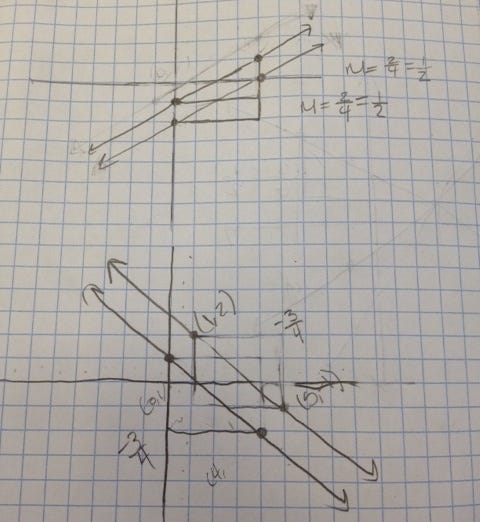
They seem happy and gullible at this point.
Best time to take advantage of them.
Me: Show me your arms again. Wave them. Twist your hands like this. Do this… now this...
These kids kill me. So damn funny. Like monkeys—doing everything I ask.
Me: Okay, now show me perpendicular lines.
Yikes.
Maybe—a fourth of them show crossed arms at right angles. The rest? All kinds of flailing.
Me: What are perpendicular lines?
Students: They cross. They intersect. They cross at right angles. Like an X.
I hold up my arms in a dramatic X—but intentionally off by 30 degrees.
Me: Like this?
Students: No! More straight—like this. Yeah, that’s it!
Me: I heard “right angles.” Is that true?
Students: Yes!
Me: Draw me another line, please. This one goes through (–2, 0) and (2, 1). Then draw—as best you can—a line perpendicular to it.
Holy cow. Even the kids who just said “right angles” and “ninety degrees” draw... not that.
One student’s sketch is actually pretty good, so I show it to the class.
Me: C’mon now. Try again. Then what should you do?
Student: Find their slopes!
We look at one student’s attempt. Her second try is better.
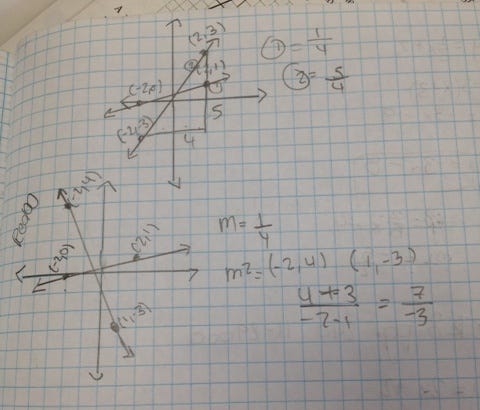
(The first line has a slope of 1/4.)
Unfortunately, a few kids who do draw a decent-looking perpendicular line end up calculating its slope as 4—when it should be –4.
We go through three sets of these.
Their descriptions of the slope relationship: opposite, inverse, flip-around, reciprocal, upside down.
I don’t care what they call it right now—because when I give them a line with slope 3/7, they know a perpendicular line has slope –7/3.
When one is –8, they know the other is 1/8.
This time, we do it differently:
Everyone draws the same original line.
Instead of trying to eyeball the perpendicular, I ask them to:
Find the slope of the original.
Find the perpendicular slope.
Use that to draw the new line—from any point on the plane.
They think it’s cool that they can start from anywhere.
I’m saved by the bell.
And I think—no, I know—this is still better than if I’d just told them.