


I just found these two photos from 6 years ago, right before we went remote due to COVID:


I was a math coach for a K-8 school district, and a 4th grade teacher asked if I could teach a lesson on prime numbers. I immediately thought of Prime Climb.
Prime Climb is a much-loved board game by Dan Finkel of Math For Love, but teachers—myself included—have used it as a lesson with students, and it’s really fantastic. Here's what the first 20 numbers look like:
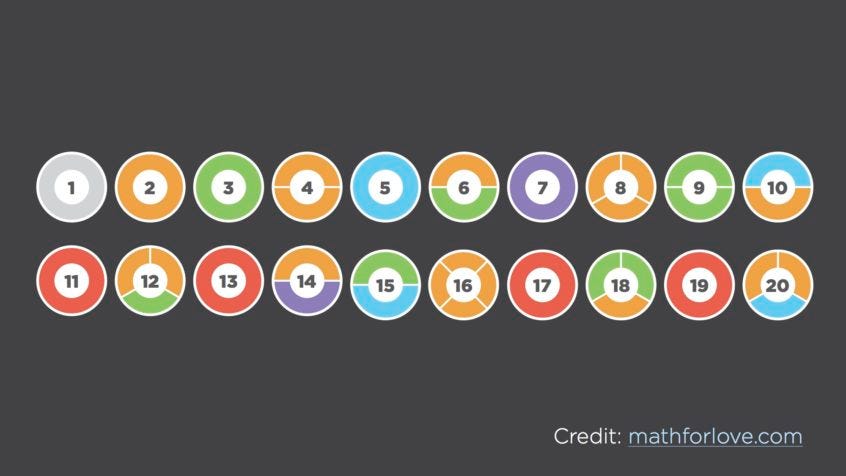
I showed students these first 20 circles and asked them to notice and wonder. This was a class that seemed very reluctant to share in small groups or write down their ideas. But once we got going, it was hard for them to stop. After they shared everything they could notice and wonder, I asked them what 21 might look like. How about 42? How about 31? The kids were engaged the whole time.
But last week I got to repeat this lesson with a spirited and thoughtful 3rd grader who makes me miss being in the classroom terribly. I showed her the chart above. Same ask: tell me what you see.
She immediately said, “Fractions!”
“You see fractions? Where?”
She pointed to the sections in some of the circles.
Her eyes then tracked the colors. “Five, ten, fifteen, twenty… are blue.” “Green is three, six, nine, twelve… fifteen… eighteen.”
She exclaimed, “The red numbers are odd!”
“They are… But seven and nine are odd…”
She helped me out: “Because seven and fourteen are purple.”
I may have helped her with the 8, why it has three orange sections. Then she said the most delightful thing—I had to ask her to repeat it. She said, “The circles that are not divided… those numbers cannot be created!” I knew what she meant because she was “creating” the other numbers by multiplying their factors.
“Those are prime numbers. Have you heard of prime numbers?”
She immediately said, “They are like primary colors! Red, blue, and yellow… you can’t create them.”
Two remarkable things she did:
She recorded her thinking! “orange = 2’s,” “green = 3’s,” etc. And of course, labeled the red as “primary numbers.”
When I asked her what number 21 would look like (and then 35, and then 23), you can see her listing out the colors and going through each color, naming the multiples out loud, then putting an ✗ if it’s not possible and a ✓ if it is.


I can't mention Prime Climb without sharing Multiplication by Heart—a visual and pattern-based approach to fluency practice.
It was only today, as some of my students struggled to read the word composite, that I realized the word "composite" comes from the word "compose," which helped me to finally understand why, even thought 1 is not prime, it would never be appropriate to call it composite, because it is not "composed." Your students' noticing about the fact that primes are not created is spot on and the connection to primary colors is brilliant! I am certain that this will be "factor in" to every conversation I have about prime numbers from here on out!!