


Don Steward posted this on Sunday. Like Don, I really like this task and think it has a certain Malcolm Swan je ne sais quoi about it.
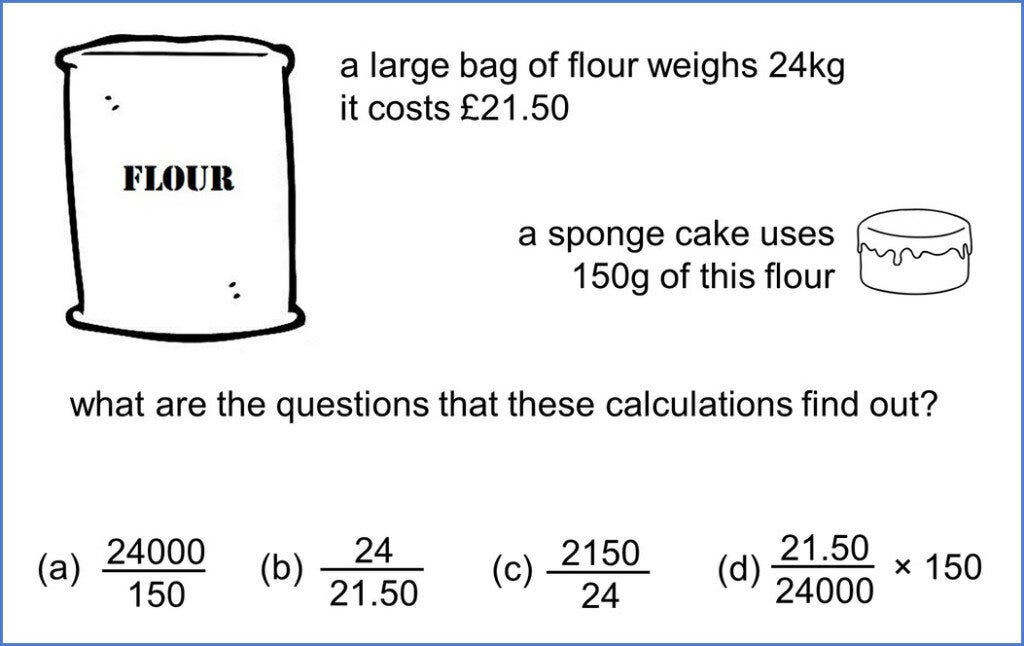
I only showed the top part of the image to my 6th graders and gave them 2 minutes to write down what they noticed.
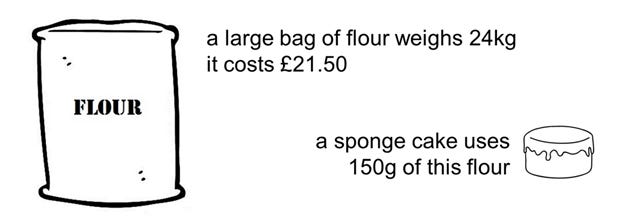
In addition to the obvious details, students pointed out:
It takes a lot of grams to make a sponge cake.
A kilogram must have a lot of grams in it.
The units are different—grams for the cake, kilograms for the big bag.
This problem doesn’t have a question.
The sponge cake has no price.
There’s frosting on the cake.
You need to convert kg to g.
The cake is heavier than it looks.
The cake is really small and the flour is really big.
There’s not much information.
You have to convert 24 kg to grams.
It uses only a small amount of the flour.
Then I gave them 2 more minutes to write what they wondered.
Some of their wonderings:
How much does the sponge cake cost?
How many sponge cakes can you make?
How big is the sponge cake?
How do you convert kg to g?
Is the sponge cake good?
Is 24 kg <, =, or > 150 g?
What will we have to solve?
Will we have to convert units?
How many grams are in a kilogram?
How many krumkakes can you make with that bag of flour?
How long will it take to bake the cake?
What’s a sponge cake anyway?
How much flour is left?
What flavor is the cake? (Sorry. I’m hungry!)
What are you wondering that I’m wondering about?
Will we have to find a price or figure out something about portions?
Then we moved on to providing the questions that would go with the four calculations shown below the image. This part was really tough. While 21 of 31 kids came up with the correct question for part (a), they struggled with parts (b), (c), and (d).
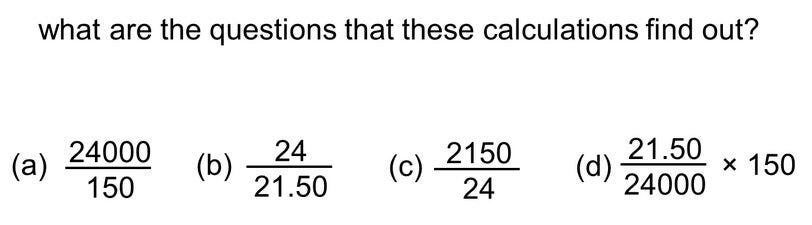
The most common (incorrect) question for part (b) was:
"How much does 1 kg of flour cost?"
(I’d swapped out £ for $.)
Eventually, we used calculators to get the numerical answers. For part (b), they saw that 24 ÷ 21.50 ≈ 1.12. If $1.12 were the cost per kilogram, then 24 kg should cost more than $24. But we already know the bag costs $21.50. Hopefully, they notice the contradiction and go back to revise their question.
This task gave us a lot to talk about—especially with units. I always follow up with:
"What does your answer mean? What unit or units does it carry?"
Too often, kids don’t know what to do with a word problem. They throw operations at it based on number size or format. Big number and small number? Must be division. Two fractions? Add. Because that’s what worked last time.
I’ll also do this task with my 8th graders because I suspect they’ll struggle too. And that’s exactly the kind of struggle we need—now, not later. This task gets them thinking about ratios—which is the most important math thing of all the math things.
Don Steward was spot on with this one. I'm grateful he shared it.
Reversing the question really can flip the cognitive demand—and invite deeper thinking.