


Near the end of class, I pass out the review questions and say something like:
The Chapter 3 test is scheduled for ___. To prepare, I want you to look over the ten problems on this sheet. You’re more than welcome to work on them, but you don’t have to — not for me, anyway. What I do need is this:
Pick two questions that you feel confident about, that you have no problem solving.
Pick two questions that you’d like help with the most.
That’s it.
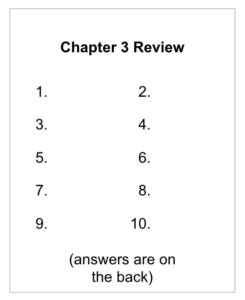
And because I teach actual human students, the questions start rolling in. So I come prepared with some possible answers (PAs):
Q: What if I’m confident in more than just two?
PA: That’s fantastic! But nobody cares. Just give me two.
Q: What if I need help with more than two?
PA: That’s why I said the two you need help with most.
Q: What if I can do all of them?
PA: Then don’t mark any down tomorrow. Or just pick one. Also — congrats, you get to help write the answer key.
Q: What if I don’t feel confident about any of the questions?
PA: Thank you for that honesty. Try a couple at home and email me if you get stuck — the answers are on the back.
Q: Can we do the problems for extra credit?
PA: No.
Q: How many questions will be on the test?
PA: Ten. Or maybe thirty-five. Depends on what you tell me about these.
The next day:
The whiteboard already has two columns drawn. Students know to give two tally marks in each — one in the "confident" column, one in the "need help" column.
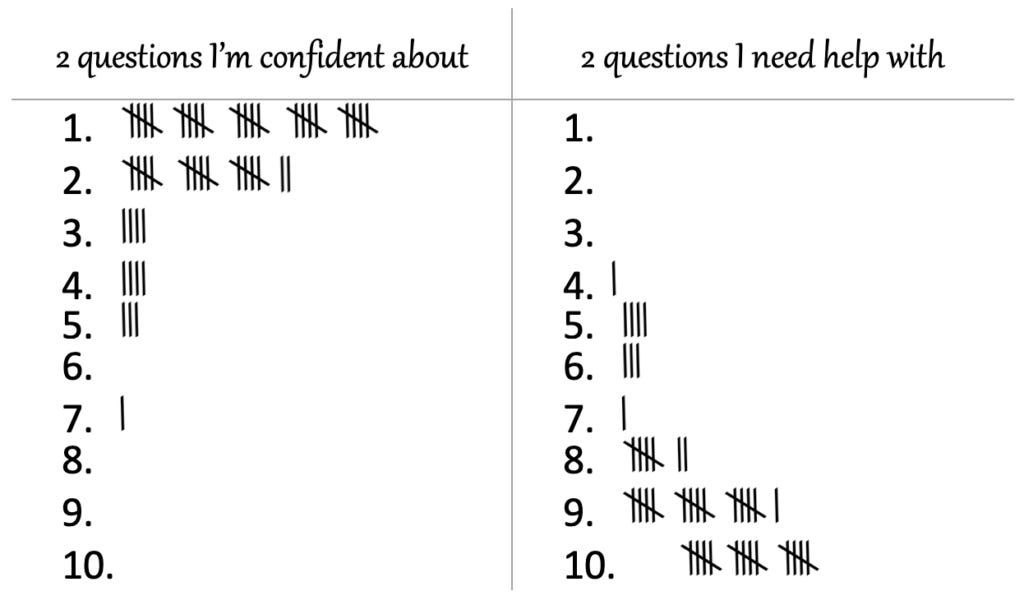
If I were to do this again, I’d consider sending the questions via Desmos — using a checklist question so I get the tally automatically on the teacher dashboard.
I focus on the right-hand column (the ones they need help with):
We’ll start with question 4. At least four of you marked this as needing help. I’d love for one of you who felt confident to walk us through it.
We continue this way down the list. Students end up learning more from each other, especially during review. And I get a chance to check for understanding — because sometimes the “confident” student turns out to be confidently wrong, and we all learn from that too.
I ask them to do the identifying at home — not in class — because I want them to do it without peer pressure or distractions. I want them to look back in their notes, check the textbook, Google things, or ask for help. I want honest feedback.
Creating the Test:
After we review, I will build the test using four questions directly from the review:
I choose two from the left column (the most confidently marked).
I choose two from the right column (ones we reviewed in class).
These are verbatim. The sighs of relief when students see those same questions? Pure gold.
It’s also my selfish way of avoiding the pain of grading a test with a zero. It lets me sneak in a little confidence boost.
This same routine works for homework too:
Assign the homework, but instead of having them do it, ask them to identify:
Two “easy” questions
Two “tough” questions
Let’s stop making them work on problems they already know how to do. Let’s use class time to focus on the ones they don’t. Promise me you'll only step in to show me how to solve the problem when no other student in the class can.
Even then, I’d say:
Can someone at least get us started? Just take it as far as you can — I’ll take over from there.