


My 7th graders have a question on their exam that asks them to put eight numbers — a mix of integers and fractions — in order of their distance from 0 on the number line, starting with the smallest.
It’s a good question. But it’s a pain to grade.
Let’s simplify for a minute. Suppose the question is:
Put these numbers in order from least to greatest:
5, 7, 2, 3, 1, 4, 6, 8
The correct order is:
1, 2, 3, 4, 5, 6, 7, 8 — worth 8 points.
Now, let’s say a student gives this order:
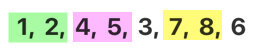
1, 2, 4, 5, 3, 7, 8, 6
Only 1 and 2 are in the correct spots. So... does that mean 2 out of 8?
But wait — 4 and 5 are together. So are 7 and 8. I want to give some credit for that, even if they’re not in the exact right places.
Then here’s another student’s order that feels worse to me:

The more I thought about it, the more I realized:
Grading these ordered lists fairly is hard. And weirdly fascinating.
So I created multiple “answer sets” (labeled A–J), and came up with a few different ways to score them. Then I tested each scoring method to see if it broke my invisible fairness barometer.
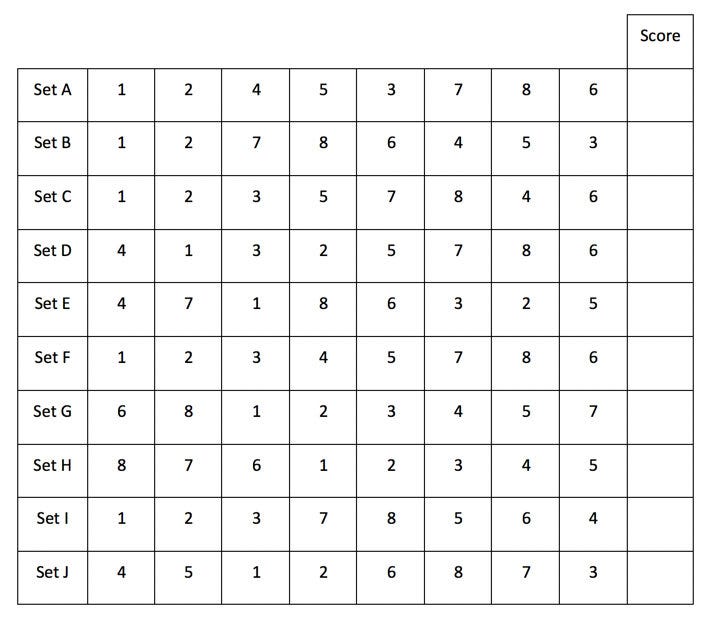
And then I thought, What if I had students think about this too?
If you’re interested in playing along, here’s the spreadsheet I used:
Scoring Spreadsheet — Add Your Scores
(Feel free to add your name in row 1 and link your Twitter handle, if you’d like.)
Also, I later learned that @MrHonner had a similar question years ago:
Order These Things From Least to Greatest
I’d love to find a way of scoring that even half of us math teachers can agree on. Meanwhile, my students are getting better at reasoning why they put the numbers where they did — which may be the best outcome of all.