


One of the more enduring lessons I do with my algebra class is having them use Excel for problem solving. No idea why I haven’t written about it before—I’ve been teaching this strategy for at least five years now. (And I don’t recall reading many teacher blogs about using Excel this way either.)
Hand-Holding
I start with this classic (5th grade?) problem:
There are 53 horses and cows in Farmer John’s farmyard.
There are 21 more cows than horses.
How many of each type of animal are there?
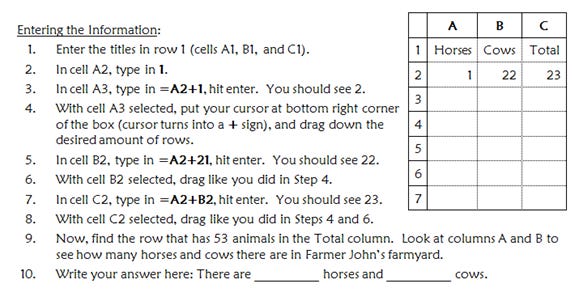
I let them wrestle with it for a few minutes. Most will say they’re using guess-and-check. Then I show them how to set it up in Excel—just watch and listen. After that, they grab their laptops and a printed set of instructions, and try it on their own.
The problem is intentionally easy so they can focus on getting comfortable with the tool—typing into cells, entering formulas, formatting as needed.
You Try
Then they try this one on their own:
For a play, ticket prices were $5.00 per child and $8.50 per adult.
Children bought 100 more tickets than adults.
The total box office income was $905.00.
How many tickets of each type were sold?
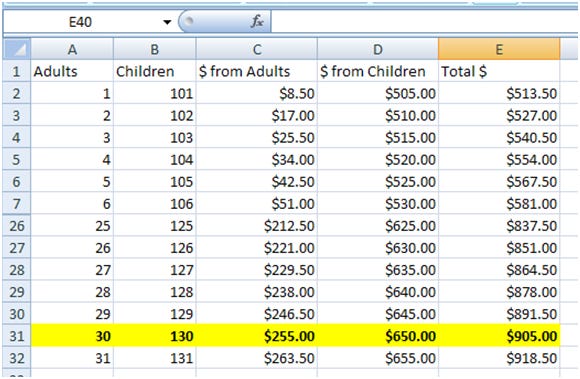
They struggle. I let them. They help each other. About 10 minutes in, I step in, asking questions, nudging them toward a setup in Excel. We work out a sample together. (I hid rows 8 through 25.)
Have Fun
After that, I give them this set of 16 problems and ask them to pick 3 or 4 to work on.
Extension
Excel is also great for problems like Daniel and the Devil:
The devil offers Daniel this deal:
“On the first day, I’ll pay you $1,000 in the morning. At the end of the day, you owe me $100.At the end of each day, we calculate the next day’s terms: I’ll double what you have left, but you must double the amount you pay me.”
Would you work for the devil for a month?
Or this classic salary comparison:
You just got a job at Jimmy’s Skateboard Shop. You can choose between two salary plans:
Plan A: $120 per week + 10% of sales
Plan B: $90 per week + 15% of salesYou expect to sell about $400/week. Which is better?
What if it’s November or December and you’re selling $1,000/week?
I love it when students ask if they can use Excel to solve a problem—especially when we get to systems of equations.
Just one more strategy in their toolbox.