
My algebra kiddos are doing Dan Meyer’s Stacking Cups.
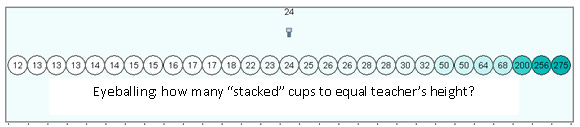
Just eyeballing
I hold up a 12-oz Styrofoam cup and ask the students to estimate how many cups it would take to stack up to my height. I say:
I will not answer any clarifying questions regarding this—just make your estimate in whatever way you think I mean by stack.
Of course, hands shoot up anyway. I remind them: no clarifying questions. It’s clear they’re dying to know what I mean by stack.
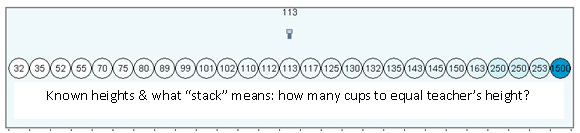
They jot down their guesses on a quarter sheet of paper. Here are their 29 estimates—median: 24 cups.
Given the heights
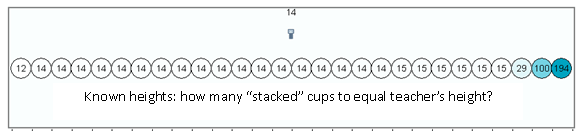
Now I tell them my height is 163 cm (in my flat shoes). I measure the cup height right in front of them: 11.25 cm.
Armed with this info, I ask the same question. They turn in 28 answers—median: 14 cups.
As Dan predicted, most students just divide my height by the height of the cup.
Stack 'em like this
I ask them what they'd wanted to ask me earlier. Eddie says:
By stacking, do you mean bottom-to-bottom, top-to-top, or… one inside another?
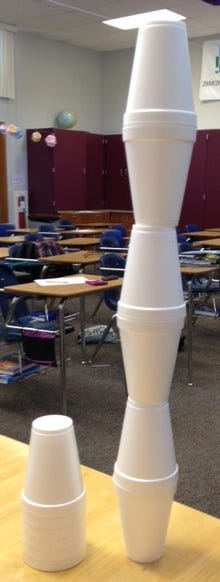
I hand him some cups and ask him to show me. At least 2/3 of the class admit they assumed I meant stacking the cups nested inside each other. (Which explains the lower initial guesses.)
Then I say:
Okay, now that you know exactly what I mean by stack, and you know my height and the height of one cup, estimate again. I’ll even stand on this table with 6 cups stacked at my feet so you can see. Go.
Their 27 new estimates come in—median: 113 cups.
We’re just getting started
I pair them up randomly. (Normally, they’re in groups of three, but pairs work better for this.) Each pair gets 6 cups. They have the last 25 minutes of class to figure out:
The equation for the stacking problem
The number of cups it would take to reach my height
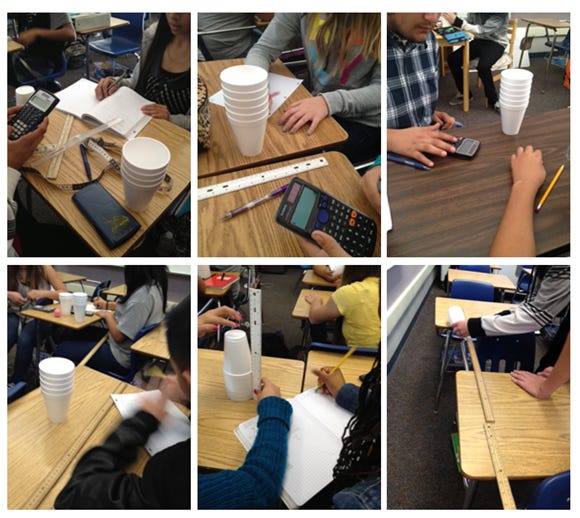
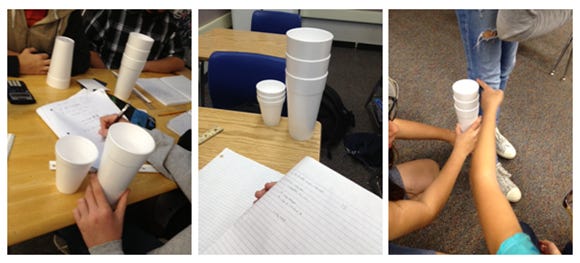
Some groups need help finding the y-intercept. A few are completely stuck. I ask a couple of questions and walk away. They’re planning to nominate me in June as their most non-helpful teacher. Whatever.
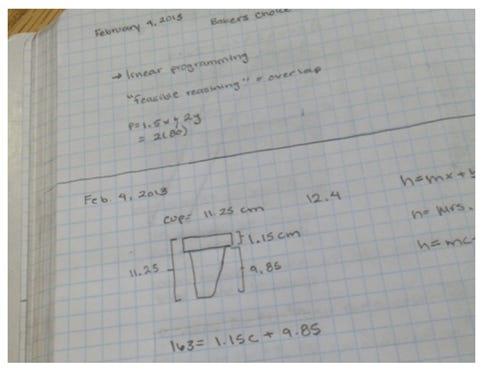
I do like this group’s drawing—even if the lip and body of the cup don’t add up quite right.
Using their equations
Most groups realize the lip height of the cup is the slope. But many also think the full height of one cup is the y-intercept. Using their equations, they estimate how many cups it takes to reach my height.
Not too shabby. My own equation gives 102 cups, which happens to be both the mode and median of their guesses.
And the actual number is…
This is the moment they’ve been waiting for.
When they come in the next day, I already have 81 cups stacked. We count out loud together as more cups are added. Our principal happens to be visiting, and he’s genuinely impressed by how engaged the students are. He joins in the countdown.
Final count: 100 cups.
Three groups—those who estimated 99, 101, and 102—are joining me for pizza next week.
Working backwards
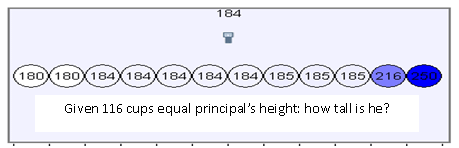
Next, I tell the kids it takes 116 cups to reach the top of our principal’s head. How tall is he?
Their estimates cluster nicely: median and mode are 184 cm. Actual height? 183 cm.
Twice the volume and half the volume
Just when they think we’re done, I pull out the 24-oz and 6-oz cups. Shriek of delight. I kid you not.
Now each pair gets just three cups of each new size. Time to do more math.
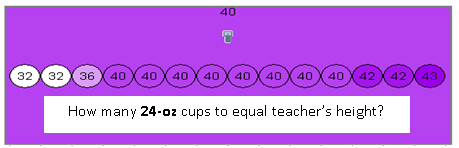
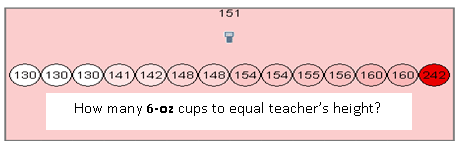
My height = 40 of the 24-oz cups, and 126 of the 6-oz cups. Their calculations are great for the big cups… not so much for the tiny ones.
This ranks as one of my favorite lessons. Huge thanks to Dan for another fab activity. Honestly, I wouldn’t have done this lesson at this point in the year—we’d already passed linear equations—if it weren’t for Andrew’s push.
Updated February 6, 2013
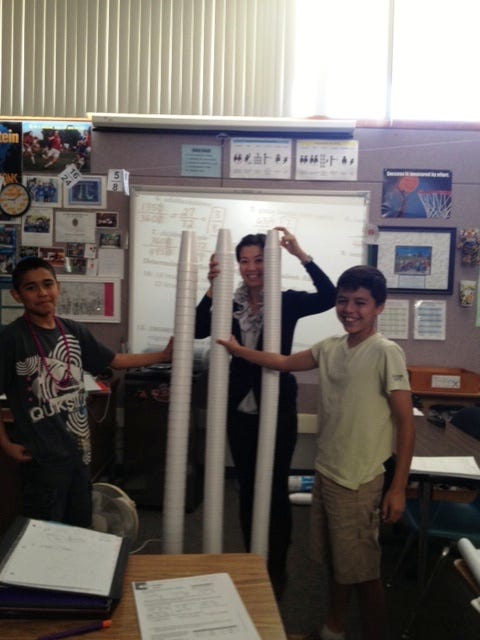
Eight more kids are joining me for pizza for getting the equations right for the 24-oz cups. Here's a photo of me and the 3 stacks, with some helpful 6th-grade boys holding them up.