


I shared these two slides in my earliest talks on the need to embed problem-solving into the mathematics curriculum.
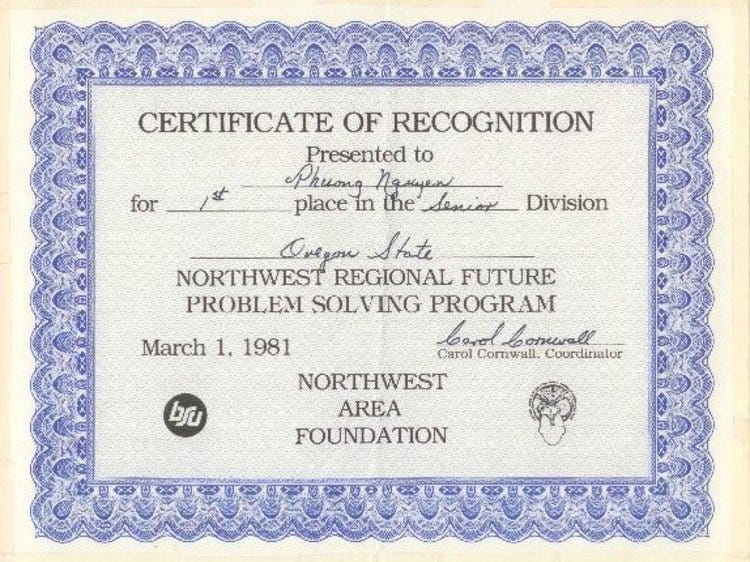
Of course, I wanted to show off. Not because I got first place (totally because I got first place), but because that piece of paper is the only personal possession that says I won something. You’d think my family would put it in a frame, but nobody cared, so I put a border of Scotch tape around it. Seeing the obvious care in my taping job is both impressive and pathetic.
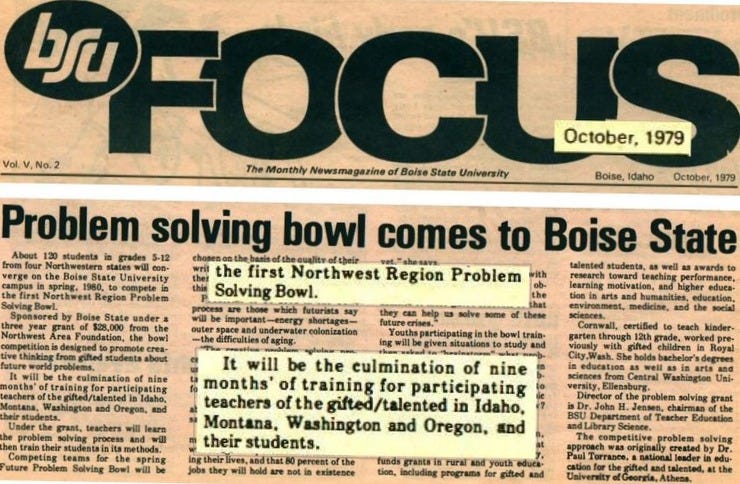
When it surfaced while I was cleaning out files (the ones that lived in a massive, tall, ugly metal file cabinet), I immediately questioned its authenticity. The internet came through with this article from Boise State two years prior to the event. Apparently, I got to participate because I was in TAG (talented and gifted). You know what’s dumb though? My English teacher transferred me to TAG — a class full of students who were actually talented and gifted — because of my writing. I remember dreading the transfer and telling my teacher, “But… I’m just trying to learn English.”
The now decades-old shift from “back to basics” to “problem solving” in school mathematics makes me wonder why we even begin with the basics and fluency as if they were absolute prerequisites to problem solving and reasoning. We don’t do that with other learnings, like riding a bike or making a batch of cookies. We teach writing by having students do three things:
write,
write some more,
don’t stop writing.
So when NCTM (1980) stated that problem solving needs to be “the focus of school mathematics,” we each went our separate ways and implemented what we thought that meant.
Those “separate ways” might be what I read in Chapter 3 of New Directions for Elementary School Mathematics: 1989 Yearbook (Schroeder & Lester), where teachers’ approaches to problem-solving instruction fall into three categories:
Teaching about problem solving
Teaching for problem solving
Teaching through problem solving
While it’s the third approach — teaching through — that I subscribe to and advocate for, it’d be foolish (maybe even impossible) to ignore the other two. I believe about and for are natural byproducts when teaching through. The converse is not true, though. The first two approaches don’t yield problem solvers and deep thinkers in the same way that teaching about bicycle wheels and chains doesn’t yield bike riding. At least it doesn’t elicit the wind-in-your-hair kind of joy that comes from actual bicycling.
Below is the best evidence I have that we’re not on the same page:
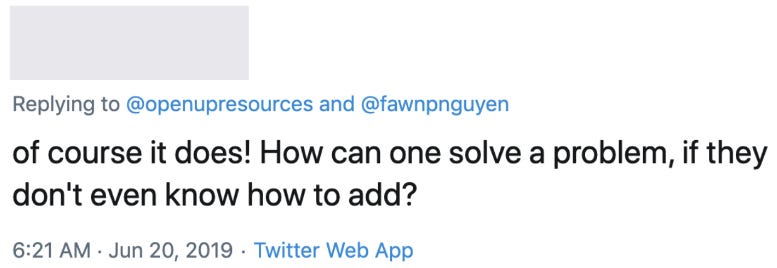
This person tweeted a reply when Open Up Resources quoted something I said in a talk — which was to challenge all students, not just a select few, and to stop equating struggle with arithmetic/computation as an inability to problem solve.
But we can be on the same page — or at least in the same book — with a shared vision that mathematics learning must be inclusive. I wonder if the exactness of math calculation — that 2 + 5 = 7, and 20% of 80 is 16 — somehow translated into the perceived need for exactness in math teaching, particularly in its sequence. It reminds me of when a teacher observed me facilitate a lesson on stacking cups and was genuinely surprised that I didn’t teach “the y-intercept” prior to the task.
All that to say: we should start presentations with a task.