


I’ve been thinking hard about math PDs in general — like why we’re still having the same conversations that were happening more than a century ago. In my last talk, I shared a couple of lines from J. W. A. Young’s 1906 book:
The question is not how much? but how? The object is mastery… and not to train the memory, or to ingest a large bulk of mathematical fact and formulas.
Then Herbert Spencer, in 1929, stated:
Rule teaching is now condemned as imparting a merely empirical knowledge — as producing an appearance of understanding without the reality. To give the net product of inquiry, without that inquiry that leads to it, is found to be both enervating and inefficient.
Yet I — and many others — sat through the very kinds of math classes Young and Spencer warned about. We consumed mathematics passively. We took good grades as evidence of understanding. Then we became math teachers and patted ourselves on the back when our students’ test scores rose.
At CAMT in Fort Worth last month, I leaned over to Sara VanDerWerf and said something like, “I know how to solve the whole PD thing… Teachers meet regularly, observe each other teach, debrief, rinse and repeat. You know, lesson study.” Sara agreed wholeheartedly because she is very kind.
When an admin laments her teachers’ excessive use of direct instruction despite the trainings, I think about food. Just because we appreciate a good dish — can taste the difference between an okay vs. excellent dish — doesn’t mean we know how to make it. We can be shown lots of great tasks and how to facilitate them, but it’s heavy lifting to be expected to replicate them with our own students. What’s more, our PDs are made up of math teachers who don’t give the genuine and creative incorrect answers our students do. We don’t get to practice asking the right questions at the right time.
The whole PD thing has too many moving parts, too many cooks stirring the pot. I don’t believe there’s one best way to teach. Sure, I vote for student-centered and problem-based learning, but those are shifts in practice — not, in themselves, classroom strategies. Broadly, I appreciate what Peter Sullivan has outlined:
The principal is the leader in teacher professional learning.
This learning is long term.
Teacher improvement must be at the center of any initiative.
All teachers already teach as well as they can, so improvement must be driven by new teacher knowledge and attitudes.
Learning improvement is connected to teaching improvement.
I also ran across this lovely thing that John Mason said about a brilliant maths teacher as someone who is “learning to balance care for learner(s) and care of mathematics.”
—
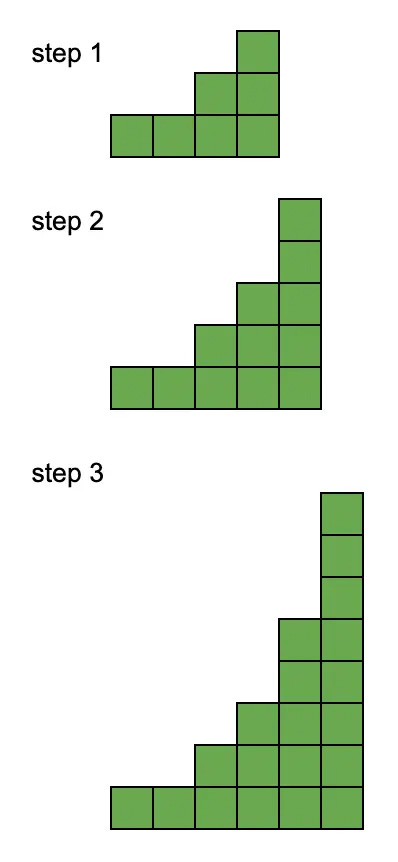
In other news, I’m happy to share that visualpatterns.org got a much-needed facelift, thanks to my daughter Sabrina, who understood exactly what needed to be done and executed it beautifully. As I went through the 471 patterns one by one again, I was flushed with gratitude for all the contributions — from Simon Gregg’s year 5 students (pattern 99) to Jonothon’s many submissions, including this one (pattern 404) that others helped me see in new ways.
I’m also happy to be working at Amplify. The year went by quickly, with a fair amount of travel — enough that I had to rehome our eight chickens. I washed their feet one last time before the nice family with two young daughters came to get them. I think chickens are so smart, but then they also step in their own shit without care, so I’m not too sure. I cried for days and wished to raise another flock before I die. This was the last egg from one of my babies. I couldn’t bring myself to use it for over a month. Then I wanted to make pad see ew, so that was that.

