


This was one of those lessons where I think I learned more than my 6th graders did. It was supposed to be a one-period activity, but I kept going off on tangents and dragging the kids along for the ride.
Over a month ago, Andrew Stadel tweeted me a photo of a Williams Sonoma display of cupcake mixes. Then last Sunday, I saw a similar display at our local mall. We both considered buying the mixes to make cupcakes for our students... but they were $15 a can, and we’d need three. So, as underpaid teachers do: we passed.
I projected the images and asked:
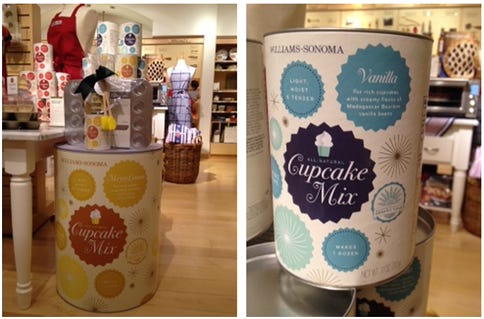
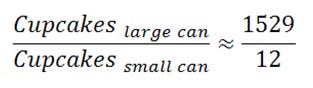
If the small container makes 1 dozen (12 cupcakes), how many cupcakes can the large container make?
Their guesses were all over the place—anywhere from 47 to 994. We made sure to clarify whether guesses were in dozens or individual cupcakes.
To help them think more spatially, I recreated the two cans—using butcher paper. (The large can was… less than beautiful, but it did the job.)
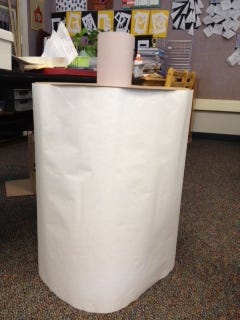
Before asking for new guesses, I wanted to explore a hunch: Are kids better at estimating 1D, 2D, or 3D relationships?
Question 1:
How many times taller is the large can than the small?

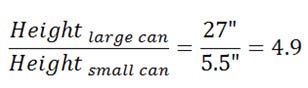
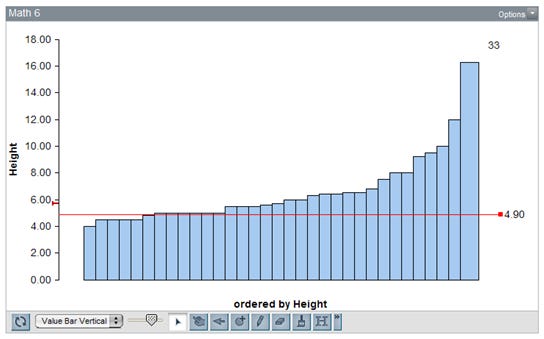
Their estimates:
Question 2:
How many times longer is the circumference of the large can?
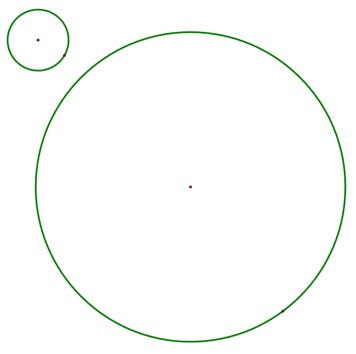

Their estimates:
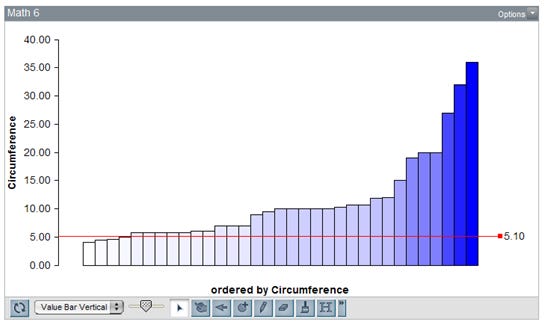
Question 3:
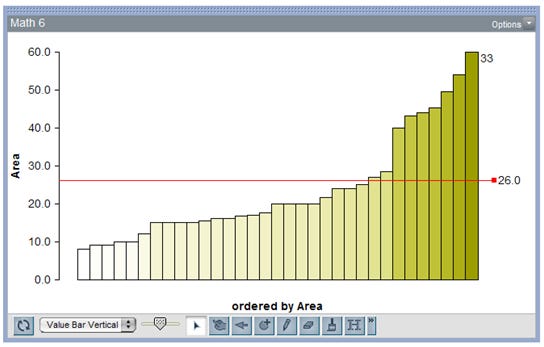
How many times greater is the area of the top of the large can?
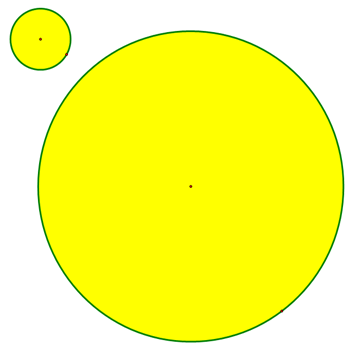
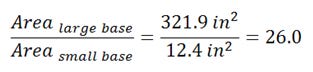
Their estimates:
Then I let students—row by row—come up for a closer look at the 3D paper cans. No touching though. I wanted to see if just seeing the physical models improved their sense of scale from the flat photo.
Their estimates after seeing the models:
Act 2: Let’s Do the Math
This turned into a mini 3-Act Lesson, so we got to Act 2:
Let’s calculate the volumes.
Yes, I carry a measuring tape with me now.
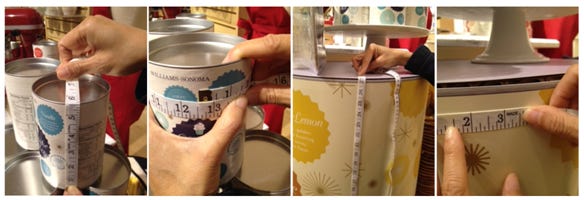
We calculated in cubic inches, since we worked with centimeter cubes all year and I wanted to offer a rare shift in units.
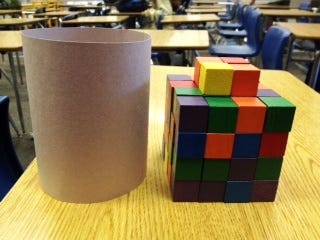
What Happened
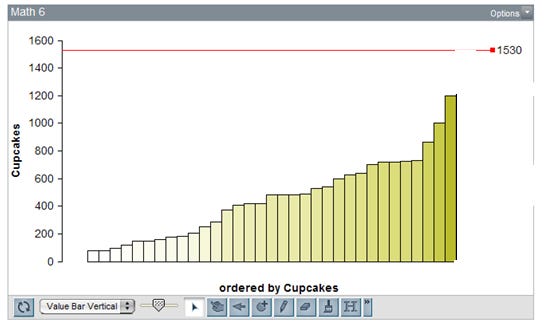
Even the adult guesses were way under:
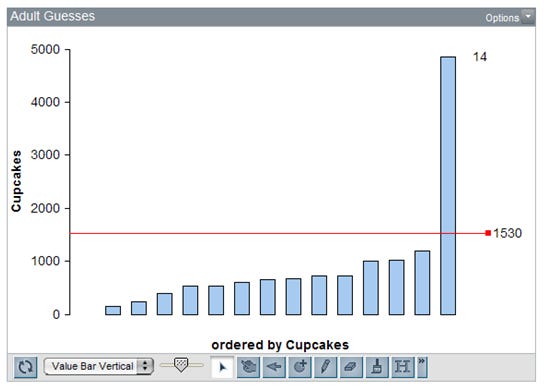
(Got more guesses after I printed this: 1,000, 182, 600, 576.)
The easiest estimates? Heights (1D). Harder? Circumferences (curved 1D). Toughest? Volume (3D)—most guesses were far too low.
The average area estimate was actually solid—28.3 from students versus a calculated 26.
Some takeaways:
Girls, in this sample of 33, were better at volume estimation.
3D models helped—though still not enough to match the actual volume.
If I let students do all the measuring themselves, I suspect their guesses would have improved.
When I placed the small can inside the big one, kids nearby actually gasped. One said, “Oh, you can fit a lot inside.”
Thank you again to Andrew Stadel for sending me the tweet that inspired all this. He also gave a fantastic presentation on 3-Act Lessons to his staff.