


I usually wait until after I’ve taught a lesson to share it, but I’m still tweaking this one and need to write it down before my brain turns into soft tofu.
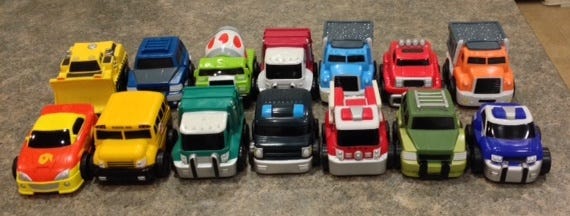
I bought 14 pull-back friction toy cars (2 sets for $30 at Costco). Amazon even has a video of how well these soft, squeezable cars can withstand toddler abuse.
On Your Mark...
Each team of 3 students gets one car.
How far the car moves forward depends on how far it’s pulled back — a nice side lesson on potential vs. kinetic energy.
The challenge is to get your team’s car to go a specific distance without going over. That target distance is revealed later.
To make predictions, teams first “test drive” their cars with pull-back distances of 2, 4, 6, and 8 inches.
Get Set...
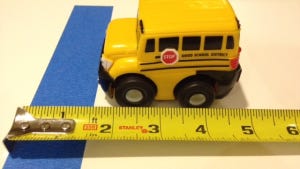
Students measure pull-backs and travel distances from the front wheels. Blue tape marks the starting line, and the front wheels are lined up at the edge.
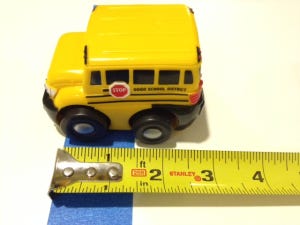
For example, if the car is pulled back 2 inches and released, the distance it travels is measured from the front of the wheels at the stop point back to the blue tape. (This one looks like about 13.2 inches.)
Go!
Each team does 3 trial runs.
They record and graph their data in Desmos.
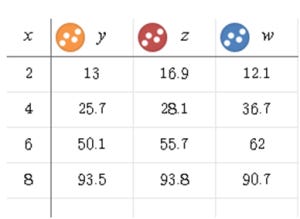
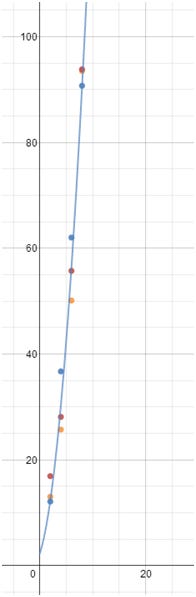
Once data is in, I reveal the target distance—say, 15 inches.
From their graph, teams extrapolate how far back they’d need to pull the car to get it to travel exactly that far (without going over). They write down that pull-back distance—it can’t be changed.
Then we line up. Each team gets one shot. Closest to the finish line without crossing wins!
Considerations
Best on hard floors. My classroom is carpeted, so we’ll do this outside.
Cars vary—some are faster than others, even with the same pull-back. The little sports car (bottom left in the photo) is the speed demon.
I couldn't test past 8-inch pull-backs on my kitchen floor, but the graph looks parabolic.
The data’s kind of a mess, right? But beautifully so.
Ginny from Mathalicious happened to be in my kitchen while I was testing. She gave me that look—the one that says, “Has empty nest syndrome finally claimed you?” Probably. Still worth it.
This should be fun. I’ll report back with pics.
[Update December 1, 2014]
Jon Orr did this lesson with his Grade 9 students and wrote a great summary.
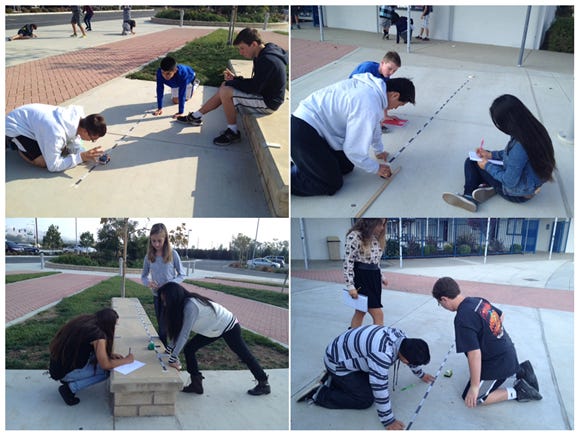
Here are a few pics from my class:
And a couple of video clips: