
Heya, back-to-back post about a problem from Five Triangles Mathematics.
When I tweeted how much I love this problem, a few people did not feel the same way. But here are my reasons for appreciating it:
It’s a leveled-up “working together” problem that I hadn’t seen before.
It involves both percentages and fractions.
I can solve it using rectangles. (I was asked on Twitter how I’d do this, hence this post.)
I had to work on this problem. That’s a big one for me.
We should assume that if we’re teaching a particular math subject—Geometry, Statistics, or Calculus—we can easily do all the exercises in the textbook. Exercises help us practice a specific skill. But a problem should make us think. I hope I’ve encouraged enough problem-solving with my students that they’ve come to value the kind of problem where:
You struggle.
You don’t know how to start.
You get stuck.
You’re frustrated.
You ask others for help.
You leave it and come back another day.
Also, I love the Five Triangles site in general for a couple of reasons:
The Geometry problems are simply stated and interesting. They make me pause and think—very few are automatic gimmes.
Solutions are not posted. I really appreciate this. If they were, we might be tempted (mainly due to lack of time) to peek too early before we’ve had a chance to wrestle with the problem. “Anticipating” is the first of the 5 Practices for a reason—it gives us insight into how students might approach the task.
I did retype the problem to make it easier to read and track, and I numbered the paragraphs for quicker reference.
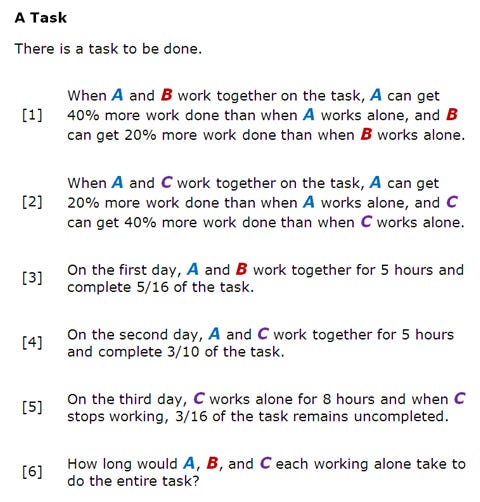
How we worked through this problem. Colors and all:
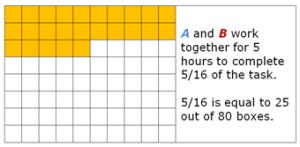
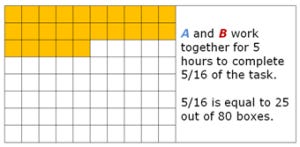
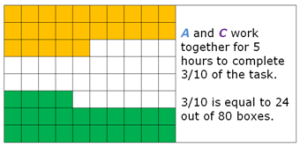
We drew a rectangle to represent the task. It has an area of 80 square units because that's the least common denominator of the three fractions in the problem.

This grid represents the task, so we use it to show the amount of work done. Paragraph [3] is our first concrete piece of information.
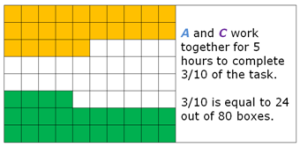
We continue to fill in the work done as described in paragraph [4].
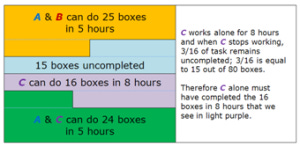
Paragraph [5] is the first piece of info that gives us C’s rate. C does 16 boxes in 8 hours, so C can do the full task—80 boxes—in 40 hours.
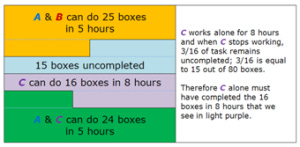
With C’s rate, we revisit paragraph [2]. C’s hourly rate working alone is 2 boxes/hour, or 10 boxes in 5 hours. But working with A, C is 40% faster, so instead of 10 boxes, C can do 14 in 5 hours. From the (green) diagram, we know A and C did 24 boxes in 5 hours. Since C did 14, A did the remaining 10.
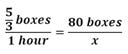
So A’s hourly rate working with C is 2 boxes/hour. This rate is a 20% increase from A working alone, so we divide 2 by 1.2 and get 5/3 boxes/hour. That gives us A completing the task in 48 hours.
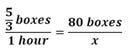
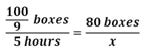
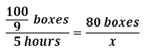
Now, paragraph [1] helps us figure out B’s rate. A’s alone rate is 5/3, but working with B, A is 40% faster, so we multiply by 1.4 to get 7/3. Over 5 hours, A can do 35/3 boxes. The yellow part of the diagram shows that A and B together do 25 boxes in 5 hours. Subtracting, B did 40/3 boxes. Now divide 40/3 by 1.2 (since B is 20% faster with A) to get B’s alone rate of 100/9 boxes/hour. That means B finishes the task in 36 hours.